

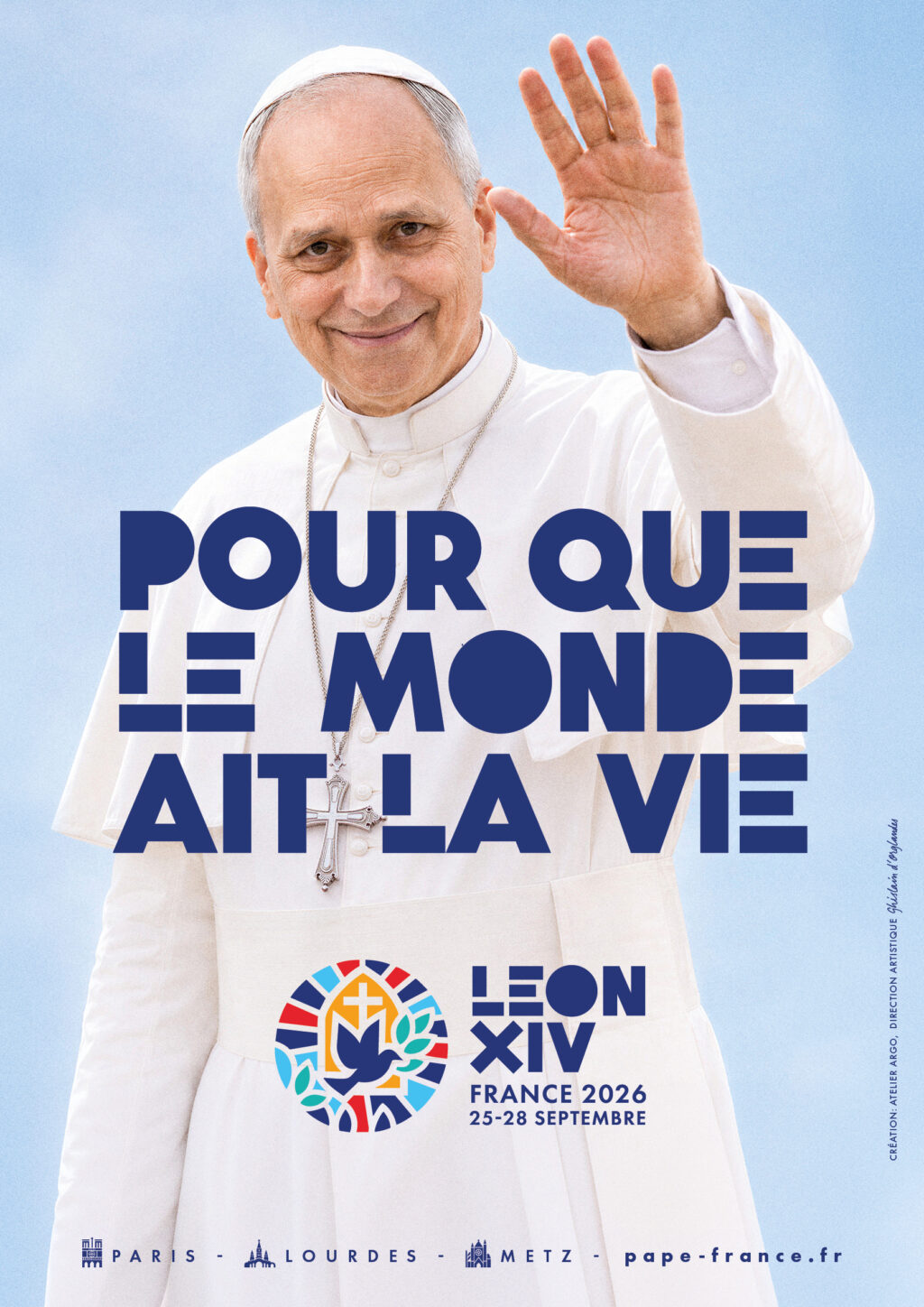
Pope Leo XIV will make his first apostolic journey to France from September 25 to 28, 2026, travelling through Paris, Saint-Denis, Lourdes and Metz while also visiting UNESCO headquarters. The official programme combines diplomacy, faith, youth, poverty, abuse survivors, the sick, interreligious dialogue and Europe. With free registrations for the main public celebrations opening on August 10, France is now preparing for a papal visit expected to bring together very large crowds.
Pope Leo XIV’s first journey to France will begin with diplomacy and end with Europe.
Between those two moments, four days will take him through very different parts of French society.
The Vatican published the official programme on August 7. From September 25 to 28, the Pope will travel from Paris to Saint-Denis, Lourdes and Metz, with an important visit to the headquarters of UNESCO.
The itinerary is intense.
But its significance lies less in the number of appointments than in their diversity.
Leo XIV will meet the French President and diplomatic representatives, address an international organisation, pray at Notre-Dame Cathedral, join young people at the Stade de France, meet people experiencing hardship, celebrate Mass in central Paris, travel to Lourdes, privately meet survivors of sexual abuse within the Church, and conclude his journey in Metz with interreligious dialogue and a message focused on Europe, peace and unity.
It gives the visit a dimension extending far beyond a traditional papal tour.
France welcomes Leo XIV as Pope and Head of State
Leo XIV is scheduled to leave Rome-Fiumicino at 7:50 a.m. on Friday, September 25, arriving at Paris-Orly at 10 a.m.
After the welcome ceremony, his first major appointment will take him to the Élysée Palace, where French President Emmanuel Macron will receive him at 11 a.m.
At 11:45 a.m., Leo XIV will meet French authorities, representatives of civil society and the diplomatic corps and deliver an address.
The sequence immediately establishes the dual nature of the journey.
Leo XIV comes to France as leader of the Catholic Church, but also as sovereign of Vatican City State.
Only a few hours later, that diplomatic dimension will become international.
UNESCO gives the journey its first global stage
At 3 p.m., Leo XIV will visit the Paris headquarters of UNESCO.
His address there will place questions of education, culture, dialogue, peace and heritage within the first day of his visit.
It is an important choice.
Before addressing one of the largest Catholic gatherings of his journey, the Pope will speak from a United Nations institution.
The visit therefore begins by placing France within an international conversation rather than treating the country as an isolated destination.
Later that afternoon, the setting will change completely.
At 5:15 p.m., Leo XIV will preside over Vespers at Notre-Dame Cathedral in Paris, accompanied by bishops, priests, deacons, consecrated men and women and seminarians.
A papal walkabout on the cathedral square is also included in the programme.
The transition from UNESCO to Notre-Dame connects two dimensions that will repeatedly cross during the journey: France’s international role and its Christian heritage.
But the first day has another destination.
Saint-Denis.
A generation gathers at the Stade de France
The evening will take Leo XIV to the Stade de France, where young people aged 17 to 35 are invited to a major prayer vigil.
The Pope will address them directly.
The choice of Saint-Denis carries meaning beyond the stadium’s capacity.
The territory is young, socially diverse and very different from the institutional Paris of the Élysée Palace or the historic surroundings of Notre-Dame.
Within a single day, Leo XIV will therefore move between the presidency of the French Republic, an international organisation, one of the world’s most famous cathedrals and a stadium filled with young people.
That movement establishes the rhythm of the entire journey.
The Pope will repeatedly leave one world to enter another.
Poverty enters the programme before the great Paris Mass
Saturday morning begins not with another major ceremony, but with people facing social vulnerability.
At 9 a.m. on September 26, Leo XIV will visit Maison Bakhita in Paris’s 18th arrondissement, a centre devoted to welcome and social integration.
He will then travel to the Institut Catholique de Paris for a meeting with members of the provincial synodal assembly, catechumens and newly baptised Catholics.
Only afterwards will the visit return to the scale of a mass gathering.
At 3 p.m., Leo XIV will celebrate an outdoor Mass between Place de la Concorde and the Champs-Élysées.
The celebration will be open to the general public.
This is likely to become one of the defining images of the French journey: a papal Mass occupying one of the most recognisable urban spaces in Europe.
Yet the programme deliberately places Maison Bakhita before it.
The contrast matters.
A journey capable of gathering huge crowds also reserves time for people whose lives are rarely at the centre of major public events.
From the centre of Paris to the silence of Lourdes
Leo XIV will leave Paris-Orly at 5:45 p.m. on Saturday and arrive at Tarbes-Lourdes-Pyrénées airport at 7:05 p.m.
By 7:40 p.m., he is scheduled to pray at the Grotto of Massabielle.
In only a few hours, the Pope will move from the Champs-Élysées to one of Catholicism’s most important pilgrimage sites.
Sunday, September 27, will then be centred almost entirely on Lourdes.
At 9 a.m., Leo XIV will meet the bishops of France.
At 11 a.m., he will celebrate Sunday Mass on the sanctuary’s prairie, followed by the Angelus.
Later, he will meet people cared for at Accueil Notre-Dame and privately visit contemplative religious sisters at the Carmelite monastery.
At 9 p.m., he will participate in the Rosary and Lourdes’ famous candlelight procession.
The crowds will remain important.
But another encounter will take place away from them.
A private meeting with survivors of sexual abuse
During his visit to France, Leo XIV will privately meet people who survived sexual abuse within the Church.
The precise time and arrangements have not yet been publicly finalised.
That uncertainty should not obscure the significance of the meeting.
France’s Catholic Church has spent recent years confronting the scale of sexual violence committed within its institutions and the consequences for victims.
Including survivors in the Pope’s first French journey means that this history will not remain outside the official itinerary.
It also creates one of the strongest contrasts of the four days.
The same Pope who will appear before enormous crowds in Paris and Lourdes will enter a meeting where numbers, spectacle and public visibility have no importance.
Listening becomes the event.
Metz turns the French journey towards Europe
On Monday morning, September 28, Leo XIV will leave Lourdes for Metz, in northeastern France.
At 10 a.m., he will participate in an interreligious meeting at the Robert Schuman Congress Centre.
At 11 a.m., another meeting will follow under a title that reveals the political and historical dimension of this final stage:
“At the roots of Europe for peace and unity.”
The location is particularly resonant.
Robert Schuman, closely associated with the region, was one of the central figures in the beginnings of European integration.
Metz itself belongs to a border region shaped repeatedly by Franco-German conflict, changing frontiers and, eventually, European reconciliation.
Leo XIV’s message on Europe will therefore not be delivered from an abstract setting.
It will come from a territory where the consequences of division and reconciliation are part of living historical memory.
At 4 p.m., the Pope will celebrate Mass at Saint-Étienne Cathedral.
The farewell ceremony is scheduled for 6:30 p.m., followed by departure for Rome at 7 p.m.
UNESCO at the beginning, Europe at the end
The geography of the journey creates a revealing structure.
It begins internationally.
At UNESCO, Leo XIV enters a global institution built around education, science, culture and cooperation.
It ends continentally.
At Metz, he turns towards Europe, interreligious dialogue, peace and unity.
Between those two points lies the French part of the journey.
And that France is not represented by one institution or one population.
There is the presidential France of the Élysée.
The Catholic heritage of Notre-Dame.
The young and diverse population gathering in Saint-Denis.
People experiencing hardship in Paris.
Catholics gathering in the open air between Concorde and the Champs-Élysées.
The bishops, sick people and pilgrims of Lourdes.
Survivors carrying the consequences of sexual violence within the Church.
And finally a border region where French history meets European history.
The itinerary therefore moves simultaneously across geography and society.
Public registration is now open
The publication of the programme has now been followed by the practical phase of the visit.
Registration for the main public celebrations opened on August 10.
Participation is free, although arrangements differ according to each event.
The public registration system covers major gatherings including the youth vigil at the Stade de France, the Paris Mass around Concorde and the Champs-Élysées, the Lourdes Mass and the final Mass in Metz.
Official registration for Pope Leo XIV’s visit to France
The complete official programme and practical updates are available through the dedicated French website.
Official programme of Pope Leo XIV’s visit to France
With several weeks remaining before the Pope’s arrival, registration gives organisers an initial measure of expected participation while allowing visitors to prepare access, transport and security arrangements.
More than a sequence of Catholic celebrations
It would be possible to describe the journey simply through its largest events.
Notre-Dame.
The Stade de France.
The Champs-Élysées.
Lourdes.
Metz Cathedral.
But doing so would miss much of what the official programme actually contains.
The smaller meetings change its meaning.
The visit to people experiencing hardship prevents the journey from becoming exclusively institutional.
The meeting with abuse survivors prevents the Church from presenting only its moments of celebration.
The encounter with young people introduces the question of transmission.
Lourdes places sickness and vulnerability alongside faith and pilgrimage.
The interreligious meeting widens the conversation beyond Catholicism.
And Metz places France back inside the European story.
These are not separate journeys.
They are different layers of the same one.
France as a bridge between two messages
Leo XIV will arrive in France through Paris, but the intellectual geography of his journey will be wider than France itself.
On the first day, UNESCO will provide a global platform.
On the final day, Metz will provide a European one.
Between them, the Pope will encounter a country through its institutions, its religious heritage, its young generation, its social vulnerabilities, its wounds and its places of pilgrimage.
That structure makes the September visit particularly significant for a first apostolic journey to France.
The crowds will provide its most visible images.
But the meaning of the visit may emerge elsewhere: in the transition from one audience to another.
From a president to young people.
From diplomats to pilgrims.
From the Champs-Élysées to people experiencing hardship.
From the public celebration of the Church to a private encounter with those harmed within it.
And finally from France towards Europe.
Leo XIV’s four days in France will therefore be more than a national visit. France will become the territory through which his message moves from the international stage to the human encounter, and from the human encounter back towards Europe.
©2026 IMPACT EUROPEAN – All rights reserved

Views: 102
More Stories
Violence Against Women: French Protesters Push Parliament to Preserve Landmark Protection Bill
Paris Pride 2026: From Political Mobilisation to a European Message of Solidarity
France’s September 29 Strike: When Pay Becomes a Question of Public-Service Capacity