

For a few minutes on August 12, 2026, geography determined how the world experienced the Sun. In Greenland, Iceland and northern Spain, the Moon completely covered the solar disc. Across much of Europe, northern North America and northwestern Africa, observers watched only part of the Sun disappear. Yet the same shadow connected them all, travelling from the Arctic towards the Atlantic and ending over Europe as the Sun approached the horizon.
A shadow begins its journey across the planet
A solar eclipse is local and global at the same time.
The alignment happens between three celestial bodies, but what an observer sees depends entirely on where that person is standing on Earth.
On August 12, 2026, the path of totality crossed the Arctic region, eastern Greenland, western Iceland, the Atlantic and the Iberian Peninsula.
Most of Europe, parts of northern North America and western Africa remained outside that narrow corridor and experienced a partial eclipse instead.
One astronomical event therefore produced countless different skies.
Greenland and Iceland meet the Moon’s shadow
Before reaching continental Europe, the eclipse crossed some of the northernmost landscapes on Earth.
Greenland and Iceland occupied privileged positions along the path.
Near Iceland, the eclipse reached its global maximum, with totality lasting up to approximately 2 minutes and 18 seconds.
There, the Moon completely covered the Sun.
The solar corona — normally overwhelmed by the brightness of the solar disc — could briefly emerge around the lunar silhouette.
Then the shadow continued south.
Its next major destination was Europe.
Spain becomes Europe’s gateway to totality
Northern Spain became the principal stage for totality on continental Europe.
The path crossed the country from west to east, reaching areas including A Coruña, Oviedo, León, Bilbao, Zaragoza and Valencia before continuing towards the Balearic Islands.
Timing transformed the spectacle.
Spain stood near the end of the global path, meaning totality arrived with the Sun already low above the western horizon.
A cosmic alignment and an ordinary sunset were approaching each other.
The Sun was being hidden twice — first by the Moon, then by the Earth’s horizon.
France stands just outside darkness
Crossing the Pyrenees changed everything.
Mainland France remained outside the path of totality.
Yet in the southwest, observers came extraordinarily close to it. Near the Spanish border, almost the entire solar disc disappeared, while Paris experienced approximately 92% obscuration, peaking at around 8:17 p.m.
This is one of the defining characteristics of a total solar eclipse.
The difference between almost total and total can be geographically small but visually enormous.
A tiny remaining portion of the Sun still produces substantial light.
Only inside the Moon’s central shadow does the solar disc disappear completely.
The eclipse reaches far beyond Europe
The totality corridor was narrow.
The partial eclipse was not.
NASA reported partial visibility across other parts of the Northern Hemisphere, including much of Canada, portions of the United States, much of Europe and northwestern Africa.
The numbers demonstrate the scale.
London saw roughly 91% of the Sun obscured, Lisbon around 95%, Milan 92%, Oslo 83%, while St. John’s in Canada saw approximately 53%.
Different continents.
Different percentages.
The same Moon.
One photograph puts Earth back into the story
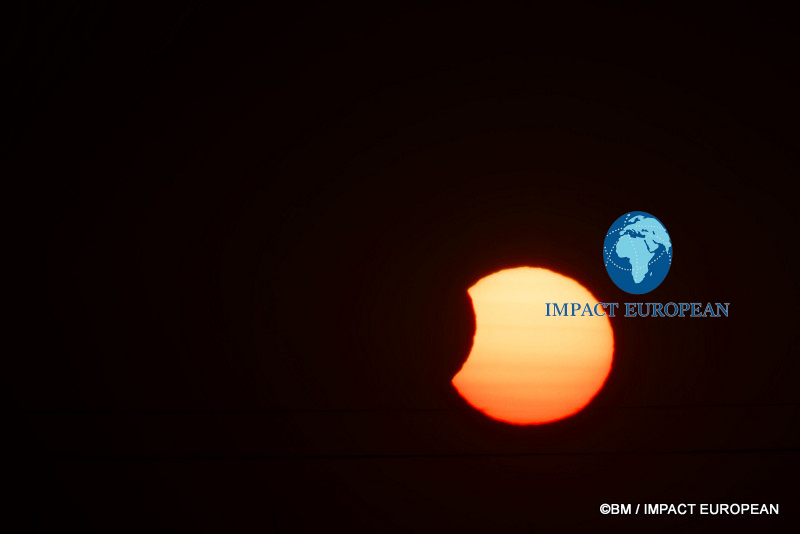
In one frame, the Sun is isolated against darkness, its circular shape visibly carved away by the Moon.
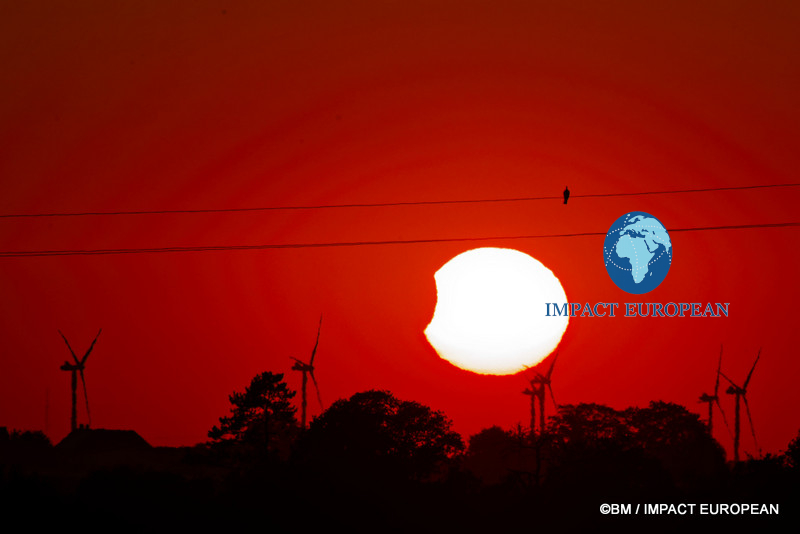
In the second, Earth returns to the image.
The sky burns red above a dark horizon. Wind turbines rise in silhouette. Power lines cut across the frame. A bird rests on one of them.
Behind this ordinary terrestrial scene hangs an extraordinary Sun.
The image captures something astronomical maps cannot.
An eclipse may be calculated across a planet, but it is always experienced from one particular place on the ground.
Humanity knows exactly what is happening — and still looks up
There is no scientific mystery about why the Sun disappeared.
Astronomers can predict eclipses far in advance, calculating their paths, timing and duration with extraordinary precision.
But prediction does not eliminate wonder.
Millions of people across Europe gathered to watch the August 12 event, with large crowds also travelling towards the path of totality in Spain.
The reaction reveals something enduring about eclipses.
Human beings know the Sun has not vanished.
They know the darkness will last only briefly.
And still they stop what they are doing to watch.
An eclipse at the edge of day
The final part of the 2026 eclipse gave the event its distinctive character.
As the Moon’s shadow moved across Spain, the Sun was already descending.
In A Coruña, for example, the eclipse began around 7:31 p.m., reached its maximum around 8:28 p.m., while sunset followed at approximately 9:41 p.m.
Across western Europe, the celestial event therefore merged with the natural end of the day.
The Moon began to release the Sun.
The horizon waited to take it.
The Sun did not disappear — our perspective did
Solar eclipses confront human beings with scale.
The Sun remains where it is.
The Moon continues along its orbit.
Earth continues rotating.
Nothing in that celestial machinery is altered because millions of people are watching.
What changes is our perspective.
For a few minutes on August 12, people separated by countries, seas and continents shared different versions of the same alignment.
Some saw a bite taken from the Sun.
Others watched it become a thin crescent.
And a fortunate few stood inside the Moon’s shadow and watched it disappear completely.
Then the light returned.
And across Europe, almost immediately afterwards, the real sunset began.
For one evening, the Sun seemed to set too early — before setting all over again.
©2026 IMPACT EUROPEAN – All rights reserved
Views: 5
More Stories
France Protests on October 17: Mass Mobilization Overshadowed by Violence Across the Country
Work Palace Opens in Paris: INSITU Brings Luxury Hospitality Into the Workplace
Rugby Pro D2: Colomiers Defeat Narbonne 49-28 to Claim Bonus-Point Victory