

There are filmmakers who tell stories.
And then there are filmmakers like Bertrand Mandico, who create cinematic states of mind.
With Roma Elastica, premiering in Cannes’ Midnight Screenings section, Mandico delivers what may be his most hypnotic and emotionally resonant work to date — a surreal, decadent and visually intoxicating love letter to cinema itself.
Set in a feverish reimagining of 1980s Rome, the film unfolds inside a version of Cinecittà that feels less like a physical place and more like a haunted subconscious archive of European cinema.
Nothing here aims for realism.
Cars look fake.
Studio sets remain visibly artificial.
Projected backgrounds intentionally reveal their own fabrication.
But this theatrical artificiality becomes the movie’s greatest strength.
Mandico understands something contemporary mainstream cinema often forgets: cinema is not reality. It is transformation.
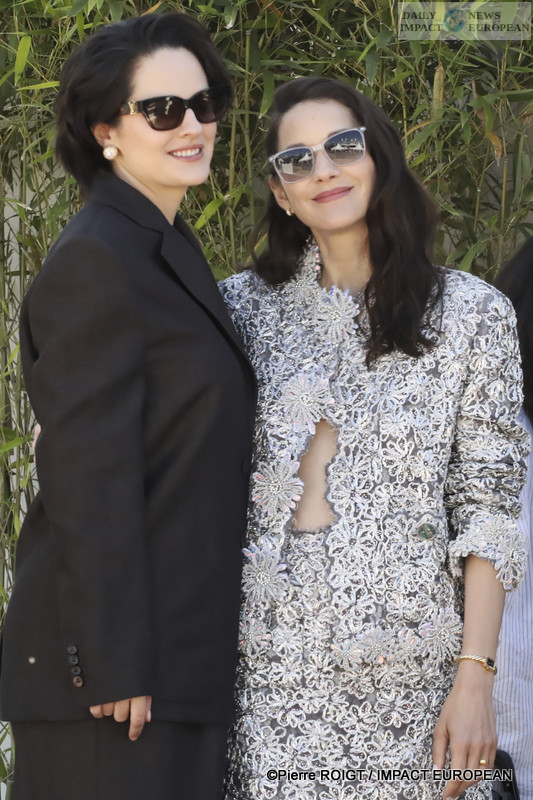
At the center of the film stands Marion Cotillard in one of the boldest performances of her career.
She plays an aging movie star filming one final production before disappearing from the screen forever.
The role could have easily become self-indulgent symbolism.
Instead, Cotillard fully surrenders herself to Mandico’s bizarre universe.
She becomes larger than life while remaining strangely fragile.
Her performance constantly oscillates between diva glamour and existential exhaustion.
Noémie Merlant provides the perfect counterpoint.
Where Cotillard embodies fading cinematic mythology, Merlant brings nervous contemporary energy — impulsive, sensual and unpredictable.
Together, they create the emotional core of the film.
Visually, Roma Elastica is extraordinary.
Mandico’s floating camera, layered superimpositions and fragmented editing create the sensation of drifting through overlapping dreams.
Time feels unstable.
Reality dissolves repeatedly.
Scenes bleed into each other through textures, sounds and emotional associations rather than traditional narrative logic.
At times, the movie feels like Fellini trapped inside a queer nightmare directed by Dario Argento after a sleepless week.
And yet the film never becomes empty style.
Because beneath all the excess lies genuine melancholy.
Mandico is mourning something here.
Not simply old cinema, but the disappearance of artistic risk itself.
The film constantly pushes against the sanitized visual language dominating modern blockbuster filmmaking.
Where contemporary franchise cinema seeks control and clarity, Roma Elastica embraces confusion, sensuality and danger.
That freedom gives the movie an almost radical energy.
Of course, the film will divide audiences.
Some viewers will find it overwhelming or self-indulgent.
Others may struggle with its refusal to explain itself conventionally.
But even its excesses feel alive.
And in today’s cinematic landscape, that alone feels refreshing.
Ultimately, Roma Elastica is less about plot than sensation.
It is cinema as hallucination.
Cinema as memory.
Cinema as dying glamour refusing to disappear quietly.
And by the end, Mandico leaves behind not just a film, but a strange emotional residue — like waking up from an unforgettable dream you can no longer fully explain.
Copyright © 2026 IMPACT EUROPEAN










Views: 4
More Stories
Paris Pride 2026: From Political Mobilisation to a European Message of Solidarity
France’s September 29 Strike: When Pay Becomes a Question of Public-Service Capacity
Pope Leo XIV in France: From Human Dignity to Europe’s Search for Peace