
Every nation has symbols that define its identity beyond its borders. For France, few are more instantly recognisable than the Tour de France and the Moulin Rouge.
One represents the world’s greatest cycling race. The other has embodied the glamour, creativity and festive spirit of Paris for more than a century.
Each summer, these two international icons come together in the French capital, creating one of the Tour’s most distinctive moments—where elite sport meets one of the world’s most celebrated cultural landmarks.
The Moulin Rouge: More than a cabaret
Long before becoming one of Paris’ leading tourist attractions, the Moulin Rouge transformed the history of entertainment.
Since opening in 1889, its famous red windmill has become one of the most photographed landmarks in France and one of the country’s strongest cultural brands abroad.
Its legendary French Cancan helped shape the global image of Paris, inspiring painters such as Toulouse-Lautrec, filmmakers, writers and generations of performers.
Today, nearly 600,000 visitors from around the world attend performances each year, making the Moulin Rouge not simply a cabaret, but one of the most influential ambassadors of French culture.
Like the Eiffel Tower or Notre-Dame Cathedral, it has become part of the visual identity of France itself.
The Tour de France: France’s greatest international showcase
The Tour de France occupies a similar place in global sport.
More than a cycling competition, it is one of the most watched annual sporting events in the world, broadcasting images of France to hundreds of millions of viewers across every continent.
For three weeks, the race becomes a travelling portrait of the country, revealing its mountains, villages, vineyards, coastlines, castles and historic cities.
The arrival in Paris is its grand finale.
Every landmark along the route becomes part of a worldwide broadcast that extends far beyond cycling.
When two international symbols share the same stage
The meeting between the Tour de France and the Moulin Rouge is not a coincidence.
It reflects something deeply rooted in French culture: the ability to unite sport, history, art and public celebration within the same event.
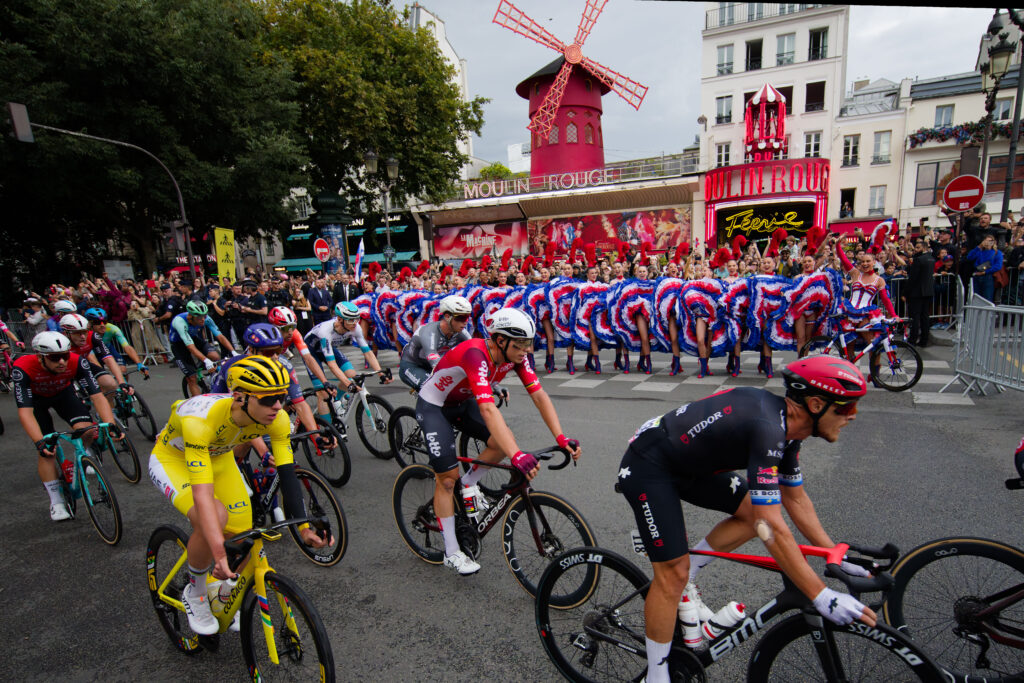
As the peloton approaches Place Blanche, the dancers of the Moulin Rouge once again perform the famous French Cancan, continuing a tradition that has become part of the Parisian atmosphere surrounding the race.
The performance does not compete with the sporting spectacle.
Instead, it enriches it by reminding international audiences that France celebrates its greatest sporting events with the same cultural confidence that has shaped its worldwide reputation.
Paris speaks to the world through its symbols
For many international visitors, Paris is immediately associated with a handful of places recognised across the globe.
The Eiffel Tower, Notre-Dame, The Louvre, The Arc de Triomphe, The Champs-Élysées.
The Moulin Rouge belongs to that select group.
Its presence during the Tour de France reinforces an image of Paris that goes beyond monuments alone. It represents a city where history is alive, where artistic traditions continue to evolve and where major international events naturally become celebrations of French identity.
A celebration that belongs to everyone
The public gathering at Place Blanche reflects the open character of both institutions.
The Tour de France has always belonged to the people, with spectators lining the roads free of charge from the first stage to the finish.
The Moulin Rouge, although renowned for its evening performances, steps into the public space during the Tour, bringing one of France’s most famous dances directly to residents, visitors and cycling fans.
It is a rare moment where two institutions, each recognised worldwide in its own field, share the same stage for the benefit of everyone watching.
Schedule
Place Blanche – Paris
5:30 p.m. – French Cancan performance
6:50 p.m. – First peloton passage
7:10 p.m. – Second peloton passage
7:30 p.m. – Final peloton passage
Every edition of the Tour de France tells the story of France through sport.
Every performance at the Moulin Rouge tells the story of Paris through culture.
When these two internationally recognised symbols come together, they create something larger than either could achieve alone: a powerful image of a country that continues to celebrate its heritage not only in museums and monuments, but also in the heart of everyday public life.
For millions watching around the world, that moment beneath the famous red windmill is more than a colourful tradition—it is a reminder that some places do not simply represent a city. They become part of a nation’s identity.
Copyright © 2026 IMPACT EUROPEAN


Official Photo Gallery (2025) Moulin Rouge
Views: 5
More Stories
Violence Against Women: French Protesters Push Parliament to Preserve Landmark Protection Bill
Paris Pride 2026: From Political Mobilisation to a European Message of Solidarity
France’s September 29 Strike: When Pay Becomes a Question of Public-Service Capacity