

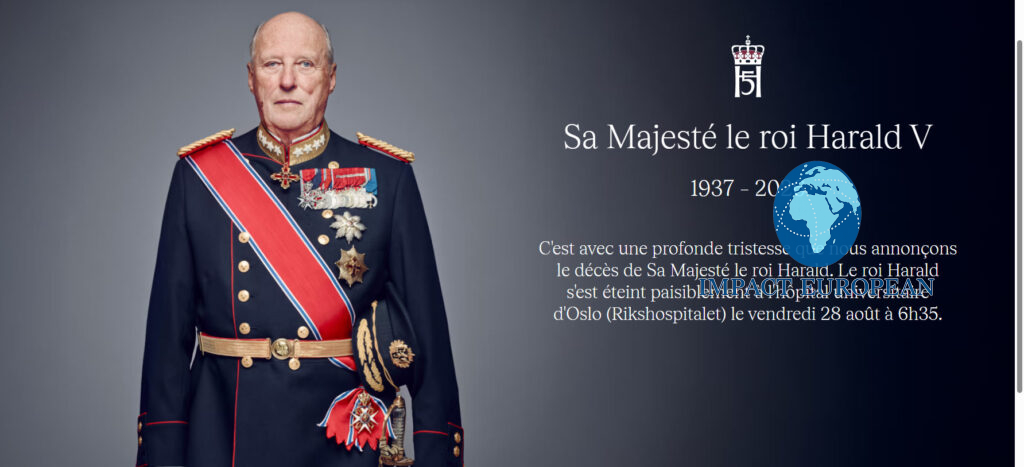
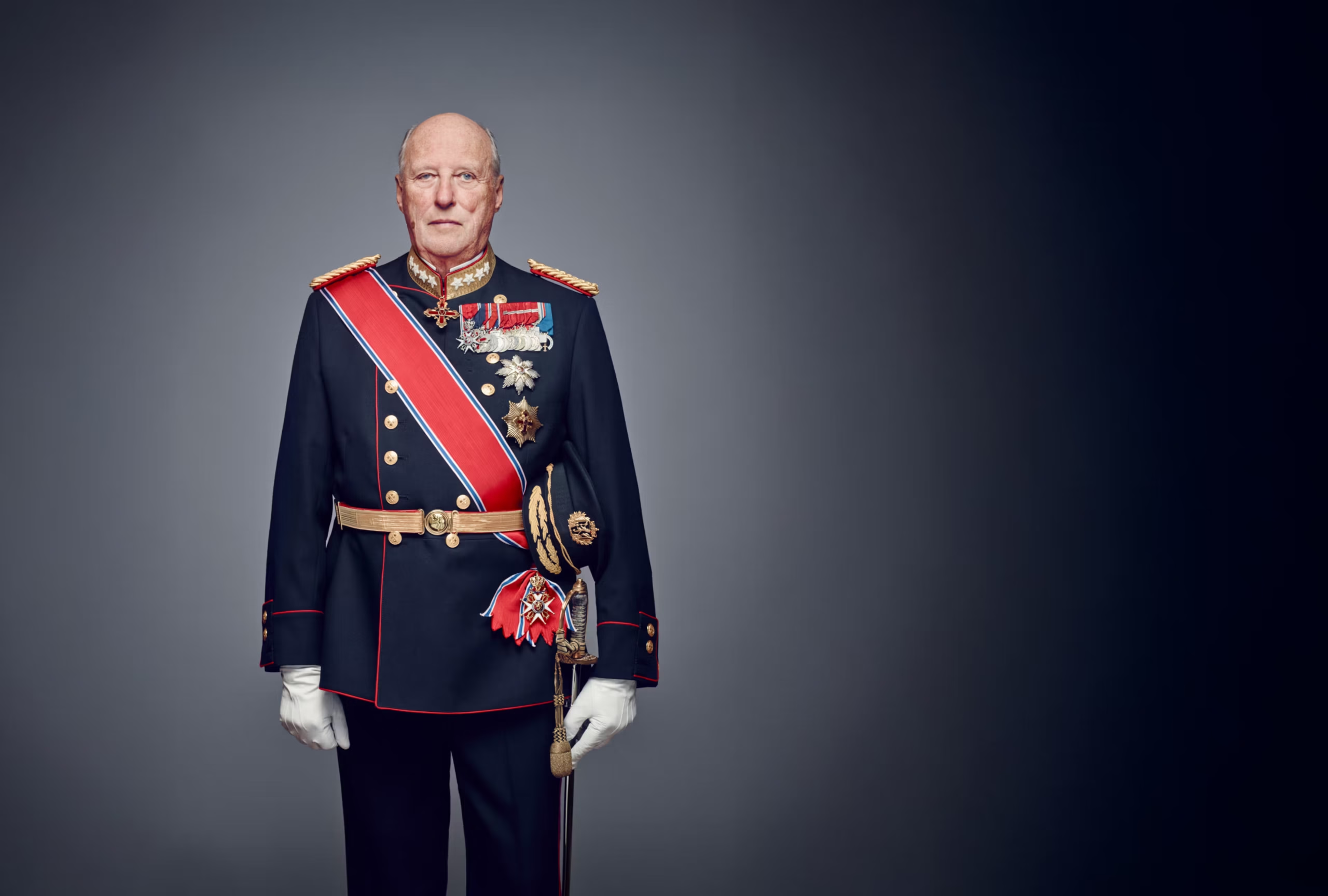
King Harald V of Norway died on Friday, August 28, 2026, at the age of 89, bringing to an end more than thirty-five years on the Norwegian throne. From a childhood marked by exile during the Second World War to decades representing modern Norway as head of state, Harald’s life followed much of the country’s contemporary history. His death also begins a new reign: his son succeeds him as King Haakon VIII, with Mette-Marit becoming Queen.
Norway entered August 28 with Harald V as its king.
At 6:35 a.m., the monarch died peacefully at Rikshospitalet, Oslo University Hospital, according to the Royal House of Norway. He was 89.
His death closes a reign that began on January 17, 1991, following the death of his father, King Olav V.
Thirty-five years later, the same mechanism of continuity places another son in the position Harald once occupied.
Crown Prince Haakon becomes King Haakon VIII.
For Norway, a new reign begins.
For the Royal Family, however, the moment begins with the loss of a father, husband and grandfather whose life had been tied to the Crown for almost nine decades.
A childhood interrupted by war
Harald was born on February 21, 1937, at Skaugum in Asker, the son of Crown Prince Olav and Crown Princess Märtha.
His early childhood was abruptly interrupted on April 9, 1940, when Nazi Germany invaded Norway.
Harald was only three years old.
As the Norwegian authorities and Royal Family faced the occupation, the young prince left the country with his mother and sisters. They initially travelled to Sweden before continuing to the United States.
For the future king, exile became one of his earliest experiences.
He returned to Norway on June 7, 1945, after the end of the war.
The eight-year-old prince came home to a liberated country.
That experience belonged to a generation of Norwegians whose childhoods had been shaped by occupation and war, although Harald experienced it from the unique position of a child born into the Royal Family.
Thirty-three years as heir
In September 1957, King Haakon VII died and Harald’s father became King Olav V.
Harald, then 20, became Crown Prince.
His preparation for the throne included military training and studies abroad. From 1960 to 1962, he attended Balliol College at the University of Oxford, studying social sciences, history and economics.
But the throne remained decades away.
Harald would spend more than thirty-three years as Crown Prince before becoming king.
During that period, one decision in his personal life would also become part of the changing history of Norway’s monarchy.
Harald and Sonja
Sonja Haraldsen was not born into royalty.
Her relationship with Crown Prince Harald therefore challenged expectations surrounding royal marriage at the time.
The couple knew each other for nine years before King Olav V ultimately consented to their marriage.
Harald and Sonja married at Oslo Cathedral on August 29, 1968.
They had two children: Princess Märtha Louise, born in 1971, and Prince Haakon, born in 1973.
Their marriage would eventually span Harald’s years as Crown Prince and his entire reign as king.
The timing of his death gives that personal history particular poignancy.
Harald died on August 28, one day before the couple would have marked their 58th wedding anniversary.
Behind the institutional transition unfolding in Norway is therefore another story: Queen Sonja has lost the man with whom she shared almost six decades of marriage.
January 1991: Harald becomes king
By 1990, King Olav V’s declining health had required Crown Prince Harald to assume duties as regent.
Then, on January 17, 1991, Olav died.
Harald became king.
Four days later, he took the constitutional oath before the Storting, Norway’s Parliament.
On June 23, 1991, King Harald and Queen Sonja were consecrated at Nidaros Cathedral in Trondheim.
Harald retained the royal motto used by both his father and his grandfather:
“Alt for Norge” — “Everything for Norway.”
It linked three generations of the modern Norwegian monarchy.
Yet the country Harald inherited in 1991 would change considerably during the decades that followed.
A constitutional king in a changing society
Harald V reigned as the head of state of a constitutional monarchy and parliamentary democracy.
Political power belonged to Norway’s democratic institutions.
The monarch’s position centred instead on constitutional responsibilities, representation and continuity.
This distinction is essential to understanding Harald’s 35 years on the throne.
Governments changed.
Political majorities changed.
Norwegian society changed.
Harald remained.
For generations of Norwegians, he became a familiar institutional presence precisely because of that longevity.
By 2026, many had never experienced Norway under another monarch.
Beyond royal ceremony
Harald’s public identity was not limited to official duties.
Sport, and sailing in particular, occupied an important place throughout his life.
As Crown Prince, he carried Norway’s flag at the opening ceremony of the 1964 Olympic Games in Tokyo.
He later competed extensively in sailing.
Harald and his crew won a world championship aboard Fram X in 1987 and a European championship with Fram XV in 2005.
He continued competitive sailing until 2022.
His connection to nature extended beyond sport. Harald was involved in establishing the Norwegian branch of WWF and served as its president for twenty years.
For a monarch representing a country whose identity is closely connected with mountains, sea and outdoor life, those interests provided a personal link with elements of Norwegian culture far beyond palace ceremonies.
A monarchy adapting without disappearing
Harald’s own life illustrated how a monarchy could preserve institutional continuity while changing some of its social conventions.
His marriage to Sonja had once challenged royal expectations.
The next generation would continue that evolution.
On August 25, 2001, Crown Prince Haakon married Mette-Marit Tjessem Høiby at Oslo Cathedral.
Exactly twenty-five years later, the couple marked their silver wedding anniversary.
Three days after that anniversary, Harald V died.
A date that belonged to Haakon and Mette-Marit’s personal history was suddenly followed by the moment for which the heir had spent his entire adult life preparing.
A son loses his father and becomes king
There is an unavoidable human contradiction at the centre of hereditary succession.
The Crown Prince prepares for the throne knowing that his accession will ordinarily come only with the death of the monarch before him.
Harald experienced that reality in 1991.
Haakon experiences it now.
For thirty-five years, Haakon served as Crown Prince. He represented Norway, undertook duties for the Royal House and acted as regent when his father was unable to perform his functions.
Preparation can establish institutional continuity.
It cannot remove grief.
On August 28, Haakon lost his father and became King Haakon VIII.
Mette-Marit, who had spent twenty-five years as Crown Princess, became Queen.
The Royal House has entered a new generation.
From wartime exile to the Norwegian throne
Harald V’s life can be measured through several dates that also tell part of Norway’s modern story.
1937: his birth.
1940: invasion and exile.
1945: return to a liberated Norway.
1957: Crown Prince.
1968: marriage to Sonja.
1991: King.
2026: the end of his reign.
Behind those dates was a life spent increasingly close to the institution he would eventually embody.
Harald was born into the Crown, but he waited more than half a century before wearing it.
Once king, he remained on the throne for more than thirty-five years.
His reign stretched from the immediate post-Cold War era deep into the twenty-first century, while Norway and Europe underwent political, social, economic and technological transformations.
Through those changes, the monarch’s constitutional position remained one of continuity rather than political direction.
Sonja between two reigns
The transition also changes Queen Sonja’s place within the Royal Family.
She knew Harald before he became king.
She waited through the difficulties surrounding their marriage.
She stood beside him as Crown Princess.
Then, from 1991, she served alongside him as Queen.
Their shared royal life ended on the morning before what would have been their 58th wedding anniversary.
That proximity between public history and private memory gives August 28 a significance no protocol can fully describe.
A country has lost its monarch.
A family has lost one of its own.
Norway begins another reign
The monarchy, however, does not end with the life of the monarch.
Harald received the Crown after Olav V.
Haakon receives it after Harald V.
The names change because generations change.
The institution continues because succession is designed to bridge precisely that moment.
For the international public, the transition will gradually become visible through new portraits, ceremonies, official engagements and the changed roles of members of the Royal Family.
But before all of that comes the death of Harald V.
The man who returned from wartime exile as an eight-year-old boy, became Crown Prince at twenty and finally ascended the throne at fifty-three has died at 89.
For more than thirty-five years, he represented Norway as its king.
On August 28, that chapter closed.
Harald V leaves the throne to history. Norway now enters the reign of Haakon VIII.
©2026 IMPACT EUROPEAN – All rights reserved
Views: 11
More Stories
Violence Against Women: French Protesters Push Parliament to Preserve Landmark Protection Bill
Paris Pride 2026: From Political Mobilisation to a European Message of Solidarity
France’s September 29 Strike: When Pay Becomes a Question of Public-Service Capacity