

France’s 108th Congress of Mayors opened in Paris on 24 November 2026 amid concerns over municipal finances, administrative constraints and the distribution of public authority. As newly elected local governments begin a six-year term and France prepares for its 2027 presidential election, the gathering highlights a fundamental question of democratic governance: whether elected representatives have the resources and authority to fulfil their responsibilities.
The political life of a country is often understood through its national institutions, its government and its presidential elections. Yet much of the relationship between citizens and public authority develops far away from the centres of national power.
It takes shape in municipalities, where decisions concerning public buildings, local infrastructure, housing and community services become part of everyday life.
In France, that relationship has returned to the centre of political discussion with the opening of the 108th Congress of Mayors and Intermunicipal Presidents at the Porte de Versailles exhibition centre in Paris.
The theme chosen for the 2026 gathering is a call to reclaim local freedoms.
For the Association of Mayors of France, known by its French initials AMF, the issue extends beyond administrative reform. It concerns the ability of municipalities to determine their priorities, finance their projects and honour the commitments made to their communities.
The opening on Tuesday, 24 November, brings these questions into focus at the beginning of a new municipal cycle and towards the end of Emmanuel Macron’s second presidential term.
Understanding France’s system of local government
For international observers, the French municipal system reflects a distinctive approach to territorial administration.
Municipalities, known in France as communes, constitute the basic level of elected local government. They range from small rural communities to major urban centres, with considerable differences in population, economic activity and administrative capacity.
Municipal councils are elected by residents, while mayors are elected by their respective councils.
Mayors exercise responsibilities on behalf of their municipalities but also perform certain functions on behalf of the French state, particularly in civil registration and the administration of elections.
This dual institutional position illustrates the historical relationship between national authority and local administration.
Alongside municipalities, intermunicipal organisations allow neighbouring communities to manage responsibilities collectively, including certain infrastructure, environmental and economic development policies.
France’s decentralisation reforms, initiated on a major scale in the early 1980s, transferred significant responsibilities to territorial authorities. However, the relationship between the allocation of powers and the resources available to exercise them remains an ongoing institutional debate.
The 2026 Congress places that relationship at the centre of discussions about the country’s future.
Two political calendars, one institutional challenge
France’s municipal elections in March 2026 marked the beginning of a new six-year cycle of local government.
According to the AMF’s presentation of the Congress on 4 November, approximately 40 per cent of local elected representatives are new to office.
Their responsibilities will extend until 2032, encompassing much of the next presidential term.
This difference between municipal and national political calendars creates practical challenges for long-term territorial planning.
A municipal infrastructure project may require several years of preparation, financing and construction. Changes to national taxation, public investment policy or administrative requirements can occur while such a project is already underway.
For newly elected municipal teams, the task is therefore not simply to identify their priorities but to establish whether those priorities can be implemented within an evolving national framework.
The opening of the Congress provides an institutional setting in which local representatives can express their concerns before national political priorities are redefined in 2027.
Fiscal autonomy and the distribution of public responsibility
One of the most significant issues facing French municipalities is the relationship between financial resources and public responsibilities.
At the AMF’s pre-Congress press conference on 4 November, André Laignel, its delegated first vice-president, estimated that measures associated with France’s proposed 2027 budget could affect municipal and intermunicipal finances by more than €9 billion through a combination of declining revenues and additional expenditure.
The figure represents the association’s assessment of potential budgetary consequences rather than a confirmed financial outcome.
Nevertheless, it illustrates the scale of concern among municipal representatives.
The central government must address national public expenditure and fiscal sustainability. Local authorities, meanwhile, must maintain infrastructure and services while planning investments that may extend over several years.
French municipal budgets are subject to financial rules that differ from those governing the national budget. Local authorities are generally required to balance their operating budgets, with borrowing primarily reserved for investment.
This distinction is important when assessing the relationship between national debt management and municipal expenditure.
A reduction in local financial capacity may contribute to national budgetary objectives in the short term, but it can also affect the timing and scale of territorial investment.
The renovation of a school, the modernisation of a public building or improvements to a local transport network may be postponed when funding conditions change.
The institutional challenge is to determine how responsibilities and financial constraints should be distributed without undermining the continuity of essential public services.
Decentralisation and the limits of administrative uniformity
The morning programme of 24 November included a debate on the organisation of local government in response to emerging challenges, with French government minister Françoise Gatel among the announced participants.
The discussion reflects a broader question facing public administrations: how to maintain consistent national standards while allowing policies to respond to different territorial circumstances.
A densely populated metropolitan municipality does not encounter the same conditions as an isolated rural community.
Their public service requirements, demographic challenges and infrastructure costs may differ substantially.
National legislation can provide common protections and establish shared objectives. Its implementation, however, requires an understanding of the circumstances in which local authorities operate.
This is where administrative flexibility becomes relevant.
Decentralisation is not necessarily a simple choice between central and local authority. It involves identifying the appropriate level of responsibility for different public functions and ensuring that the necessary resources accompany those responsibilities.
The French debate therefore has significance beyond the country’s borders.
Governments elsewhere face similar questions about the relationship between national coordination, regional diversity and local accountability.
Preserving collective representation amid political competition
The opening of the Congress also coincides with the renewal of the AMF’s leadership.
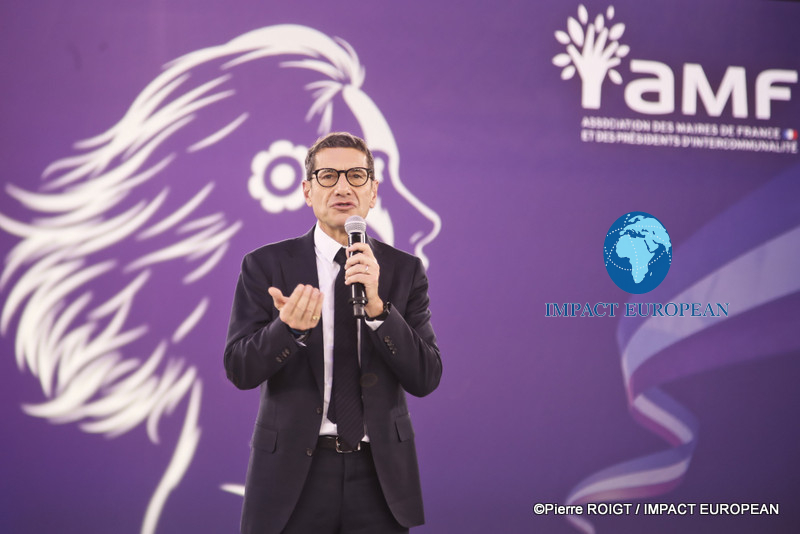
On 24 November, two candidates were seeking the association’s presidency: incumbent president David Lisnard, mayor of Cannes, and Philippe Laurent, mayor of Sceaux.
Voting was scheduled to conclude the following day.
The internal election takes place against the background of France’s approaching presidential contest.
At the association’s press conference earlier in November, Lisnard defended the compatibility of his national political ambitions with his candidacy for the AMF presidency.
He also indicated that, if re-elected, he would temporarily withdraw from the association’s leadership during a relevant period of the presidential campaign, allowing a collective leadership arrangement to operate.
André Laignel emphasised the importance of maintaining unity among municipal representatives despite previous disagreements.
The existence of joint cross-party lists for other leadership positions reflects the association’s efforts to preserve a collective institutional framework.
The issue is particularly significant because the AMF represents municipalities governed by politicians from different traditions, as well as many elected representatives whose primary commitments are local.
Its role differs from that of a political party. Its purpose is to represent the interests and concerns of municipal and intermunicipal authorities in their dealings with public institutions.
Maintaining that distinction becomes increasingly important during a period of national electoral competition.
European governance from a municipal perspective
The participation of António Costa, President of the European Council and former mayor of Lisbon, gave the official opening an international dimension.
Municipal authorities occupy an important position in the relationship between European policy objectives and their implementation within communities.
Climate adaptation, infrastructure development, energy efficiency and territorial cohesion all have implications for local public administration.
Yet a municipality’s ability to participate in European programmes depends not only on the availability of funding but also on its administrative capacity and access to relevant expertise.
Smaller authorities may encounter greater difficulties in preparing complex applications or establishing the partnerships required to undertake substantial investment projects.
The forthcoming European Union budget cycle for 2028–2034 is therefore particularly relevant to the municipal term that began in France in 2026.
Decisions taken at European level during that period may shape the resources and opportunities available to territorial governments.
Greater coordination between European institutions, national governments and municipalities could help address differences in implementation capacity.
The European dimension of the Congress reflects the fact that local autonomy increasingly operates within a framework of interconnected public responsibilities.
Territorial resilience and shared institutional responsibility
The official opening programme also included a tribute to municipalities affected by wildfires and natural disasters during the summer of 2026.
Such events expose the relationship between local knowledge and wider institutional capacity.
Municipal authorities are familiar with the communities, infrastructure and geographical conditions of their territories. National authorities can mobilise resources beyond the capacity of an individual municipality, while international cooperation can provide additional assistance.
These different levels of intervention are particularly important when a disaster affects public infrastructure, housing and economic activity.
Recovery may continue for months or years after an immediate emergency.
The costs of reconstruction can also restrict the resources available for other municipal priorities.
Territorial resilience therefore depends on more than emergency response. It requires prevention, long-term planning, reliable investment and cooperation between institutions.
The ability of municipalities to act autonomously does not eliminate the need for wider solidarity.
Rather, autonomy and cooperation can serve complementary functions within a system of shared public responsibility.
Innovation and the capacity to deliver
Running alongside the Congress, the Mayors and Local Authorities Exhibition provides a practical counterpart to the institutional discussions.
Around 1,400 exhibitors were announced before the event, reflecting the range of industries and services involved in territorial development.
Municipalities face growing demands to modernise public infrastructure, reduce energy consumption and improve access to administrative services.
Technological solutions can contribute to these objectives, but their effectiveness depends on local circumstances.
A digital service may improve administrative efficiency while creating difficulties for residents who lack access to technology. An infrastructure investment may produce long-term savings while requiring substantial initial expenditure.
For municipal leaders, innovation must therefore be assessed alongside its financial, social and operational consequences.
The question is not simply whether new solutions exist, but whether local authorities have the capacity to implement and maintain them.
This relationship between innovation and fiscal autonomy reinforces one of the central concerns surrounding the Congress.
The democratic meaning of local freedom
The debate opened in Paris on 24 November concerns more than the institutional position of France’s municipalities.
It raises a question about the relationship between democratic choice and the capacity to govern.
Local elections allow citizens to express preferences concerning the future of their communities. Elected representatives are then expected to translate those preferences into public decisions.
When responsibilities, financial resources and decision-making powers are distributed across several institutions, accountability becomes more difficult to establish.
A resident may hold a mayor responsible for a public service whose operation depends partly on decisions taken elsewhere.
Conversely, national institutions must pursue common objectives while recognising the diversity of the territories in which those objectives are implemented.
Finding an appropriate balance requires clarity about the responsibilities of each level of government.
France’s 108th Congress of Mayors offers a national expression of this wider governance challenge.
As the country’s municipal representatives begin a new term, the demand for local freedoms places the relationship between central authority, territorial capacity and democratic accountability at the heart of the public debate.
The opening day leaves that question unresolved. Its significance lies in the responsibility shared by institutions to ensure that democratic decisions can find a meaningful expression in the daily lives of citizens.
©2026 IMPACT EUROPEAN – All rights reserved






Views: 3
More Stories
Cate Blanchett lights up Paris as Christmas returns to the Champs-Élysées
Europe takes to the streets over the cost of living as France records another decline in turnout
MIF Expo 2026: Made in France takes centre stage, with a notable visit from Teddy Riner