

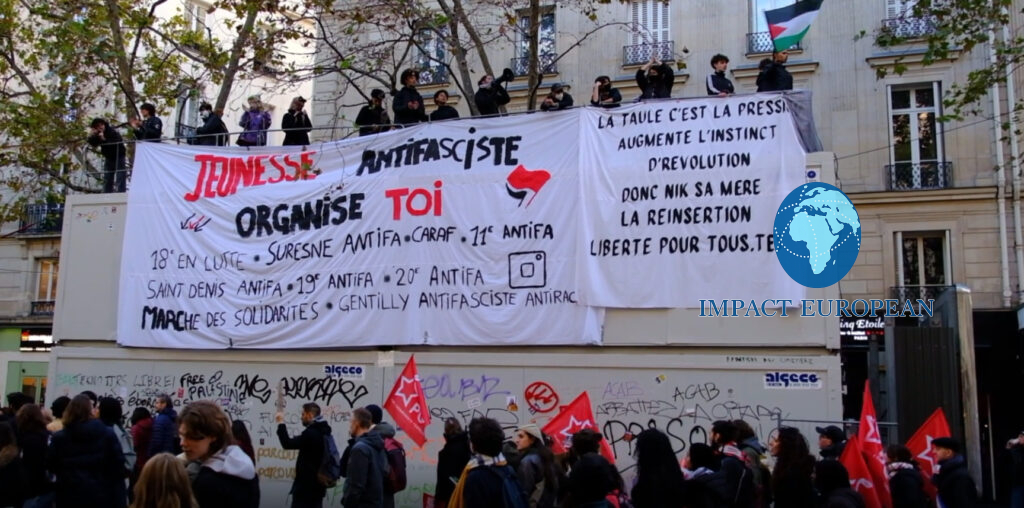
Thousands take to the streets on 5 November as France’s unions call for higher wages, stronger public services and action on employment
Paris became a major gathering point for France’s 5 November 2026 day of industrial action and demonstrations. Workers from the public and private sectors, young people, retirees and union representatives marched from Place de la République to Place de la Nation, along Boulevard Voltaire. Their demands focused on wages, purchasing power, employment, industry and public services. The scale of the demonstration, however, was disputed: the CGT reported 350,000 participants in Paris, while the Interior Ministry put the figure at 65,000.
A joint call from five major unions
The initial call for action was issued by five French trade union organisations: CFDT, CGT, Force Ouvrière, UNSA and FSU. They called on public- and private-sector workers, young people and retirees to take part in strikes and demonstrations.
Their demands included higher wages, an increase in the minimum wage, better pensions and a rise in the index point used to calculate public-sector pay. They also called for stronger public services, support for employment and industry, and greater fiscal and social justice.
Other unions and youth organisations subsequently joined the mobilisation, broadening the range of concerns represented in the streets. Education, student conditions and the future of younger generations became part of the wider debate.
The Paris route changed before the demonstration
The route through the French capital was the subject of disagreement between the unions and the authorities. The unions had initially requested a march from Place de la Bastille to Place de la Concorde. Following administrative decisions and the rejection of legal appeals, the final route ran from Place de la République to Place de la Nation along Boulevard Voltaire.
The march was scheduled between 2 p.m. and 7 p.m. A minute of silence was held before the procession in tribute to the victims of a racist attack in the Yvelines.
The demonstration brought together different parts of French society, with concerns ranging from wages and working conditions to education, public services and the cost of everyday life.
A major gap between the attendance figures
The figures released after the demonstration showed a substantial difference between the union estimate and the government’s count.
In Paris, the CGT reported 350,000 demonstrators, compared with 65,000 according to the Interior Ministry. Nationwide, the union counted 1,573,000 participants across 207 cities, while the ministry reported 575,000.
These figures should be attributed to their respective sources rather than combined into a single estimate. Without a shared counting method, the difference cannot be resolved simply by choosing an intermediate number.
The gap itself became one of the defining facts of the day, highlighting how the scale of a public demonstration can be assessed differently by unions and state authorities.
Purchasing power and the cost of everyday life
Wages and purchasing power were at the centre of the union campaign. The organisations argued that household expenses, including housing, food, energy and transport, were putting increasing pressure on workers and pensioners.
Accounts gathered in the Paris march illustrated the range of experiences behind the demands. A school psychologist described the pressure on her household budget despite earning a monthly net salary of 1,900 euros. Employees of Disneyland Paris said their pay had not kept pace with inflation and used the national strike call as an opportunity to make their demands heard.
These individual accounts do not represent every worker’s circumstances. They nevertheless show how broad economic questions translate into decisions about food, holidays, family budgets and everyday spending.
Public services, education and younger generations
The mobilisation also focused on the resources available to public services. Education unions called for additional funding, staffing and improved working conditions. Students and school pupils brought their own concerns, including the quality of educational facilities and access to higher education.
The participation of younger people gave the demonstration an intergenerational dimension. Their concerns were not identical to those of public-sector workers or retirees, but they intersected around the future of education, employment and social protection.
The debate over public services therefore went beyond government spending. It also concerned the ability of schools, public institutions and other essential services to meet the needs of the population.
A social conference announced by the government
Following the demonstrations, the Prime Minister’s office announced a social conference with trade unions and employers’ organisations for the following Monday. The stated aim was to address questions surrounding purchasing power and wages.
The announcement opened a new stage of discussion, but it did not amount to an agreement or a response to all the demands raised during the demonstration. The outcome will depend on the proposals put forward and the positions taken by the organisations involved.
The Paris march of 5 November highlighted the continuing debate over wages, public services, employment and economic security in France. For international observers, it also offers a picture of the issues shaping relations between workers, unions, employers and government in one of Europe’s major economies.
©2026 IMPACT EUROPEAN – All rights reserved
Views: 5
More Stories
Route du Rhum 2026: 115 Sailors Set Out Across the Atlantic
Paris Protests: Cost-of-Living Anger Meets Police Tensions
Paris protest puts cost of living and public freedoms in focus