

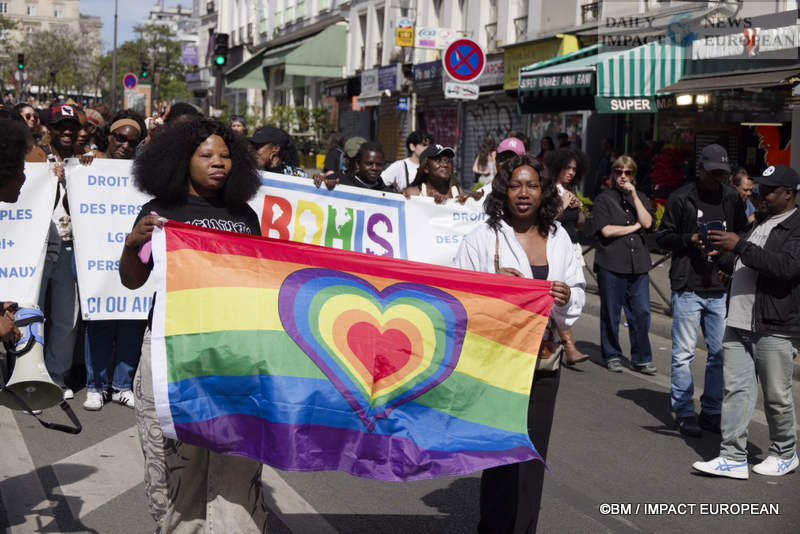
On Sunday, April 26, 2026, Paris became the stage for a powerful demonstration marking the International Lesbian Visibility Day. Hundreds of protesters, mainly women, gathered near Gare de l’Est before marching toward Place de la Bastille in what was called the Intersectional Lesbian, Afro-Lesbian and Trans-Lesbian March.
More than a symbolic event, this march represented a political statement: to make lesbian lives visible in all their diversity and complexity, especially those too often left in the shadows, even within broader LGBTQIA+ spaces.
In a festive yet strongly militant atmosphere, participants raised their voices for equality, dignity, housing rights and social justice, while paying tribute to victims of lesbophobia and denouncing the rise of reactionary and anti-LGBTQ+ rhetoric across Europe.
The event reflected a growing demand for recognition—not only as part of a larger LGBTQIA+ movement, but as a distinct political and social reality that deserves specific attention.
Organized by eight activist associations
The 2026 edition of the march was organized by eight associations and activist groups:
- Bipan Paris
- CLE
- Collectif Insurrection Trans
- DiivinesLGBTQIA+
- Féministes Révolutionnaires
- Front d’Action Bisexuel
- OUTrans
- Queer Education
These organizations work year-round on issues related to lesbian visibility, anti-discrimination policies, trans rights, housing insecurity and intersectional feminism.
For them, the existence of a dedicated lesbian march responds to a clear political need: lesbian, bisexual and trans lesbian experiences must not disappear inside the broader LGBTQIA+ acronym.
Visibility means more than representation. It means the right to define one’s own struggles, priorities and political agenda.
The choice of April 26, aligned with International Lesbian Visibility Day, gives the event strong symbolic meaning and anchors it in a global movement.
A tribute to victims of lesbophobia
Before the march officially began, organizers held a tribute to victims of lesbophobia.
A particularly emotional moment was dedicated to Caroline Grandjean, a school principal who suffered harassment because of her homosexuality and died by suicide on September 1, 2025.
Her name has become a symbol of the silent violence many lesbian women still face in professional, family and institutional environments.
Lesbophobia is not only expressed through direct insults or physical aggression. It also takes the form of social isolation, workplace discrimination, emotional exhaustion and institutional neglect.
For many participants, the march was also about transforming grief into collective action.
Remembering those who suffered becomes part of the political struggle.
Between celebration and resistance
As the procession started moving toward Bastille, the atmosphere mixed music, chants, anger and celebration.
Among the slogans heard:
“Hotter than the fascists” and “And all lesbians hate Marine Le Pen”;
These slogans reflected a clear rejection of far-right politics and the normalization of anti-LGBTQ+ rhetoric in France and across Europe.
The demonstration was not only defensive. It was also a celebration of lesbian existence, queer solidarity and public pride.
Visibility itself becomes an act of resistance.
To exist publicly, joyfully and without apology is deeply political—especially in a climate where conservative backlash is growing stronger.
Alice Coffin and the call for unity
At the front of the march was feminist lesbian activist Alice Coffin, walking behind a large banner reading:
“Lesbians, Afro-lesbians, trans-lesbians, let’s unite”
Her presence reinforced the political message of the event: unity between all oppressed communities is more necessary than ever.
Speaking to AFP, she declared:
“We are in a time when we need unity more than ever in the camp that defends all oppressed populations.”
This statement captured the spirit of the march.
The word “intersectional” in the event’s title is not decorative—it defines the strategy.
Lesbian struggles cannot be separated from racism, class inequality, transphobia, migration issues or housing precarity.
The fight is collective, not isolated.
Why a specific lesbian march?
Some ask why a separate lesbian march is necessary when Pride marches already exist.
For organizers, the answer is simple: some experiences remain invisible even inside LGBTQIA+ spaces.
Racialized lesbians, trans lesbians, bisexual women, asylum seekers and homeless queer women often find their realities overlooked.
A specific march creates a political space where these voices can exist without being diluted.
Visibility is not simply being counted inside a crowd.
It means being able to name one’s own violence, one’s own needs and one’s own priorities.
This autonomy is essential for real political progress.
Housing rights as the central theme of 2026
This year, organizers placed housing rights at the center of the mobilization.
At first glance, this may seem surprising. But for lesbian and trans communities, housing is a critical issue.
Lesbophobia has material consequences.
Coming out can lead to family rejection and homelessness. Domestic violence can force women to leave home without alternatives. Rental discrimination and difficulties accessing social housing create long-term precarity.
For racialized lesbians, trans women, migrants and asylum seekers fleeing persecution related to sexual orientation, the problem becomes even more severe.
Housing is not a secondary issue.
It is often the condition for survival.
Without a safe place to live, access to healthcare, work, legal protection and political participation becomes extremely difficult.
Intersectionality at the center of the struggle
Organizers insist that lesbophobia rarely exists alone.
It often intersects with:
- racism
- transphobia
- poverty
- administrative discrimination
- migration insecurity
- institutional violence
A Black lesbian, a trans migrant woman or an asylum seeker does not simply experience multiple separate discriminations.
These realities are interconnected and shape a specific form of vulnerability.
This is why intersectionality is central.
It allows the movement to move beyond a single narrative of lesbian identity and toward a broader struggle for social justice.
A European issue beyond France
The Paris march also reflects a wider European concern.
Across several European countries, LGBTQIA+ rights are under increasing pressure.
Far-right parties are gaining influence. Anti-gender rhetoric is becoming mainstream. Attacks on trans rights and queer education are multiplying.
At the same time, social inequality and housing precarity are worsening.
For many activists, lesbian visibility cannot be separated from broader democratic questions.
Who gets protection? Who gets housing? Who gets political legitimacy?
These are not identity questions alone—they are questions of citizenship.
Visibility as a democratic demand
For many participants, visibility is not a symbolic luxury.
It is survival.
Visibility helps:
- break isolation
- create support networks
- expose violence
- demand public policy responses
It also challenges stereotypes and offers new social narratives.
In societies where heterosexuality is still treated as the invisible norm, public lesbian existence remains a political act.
To be visible is to refuse erasure.
The Intersectional Lesbian, Afro-Lesbian and Trans-Lesbian March of April 26, 2026, in Paris was far more than a symbolic demonstration.
It was a political moment connecting memory, social justice, housing rights and democratic resistance.
By placing housing and solidarity at the center of the conversation, organizers reminded the public of a fundamental truth: equality cannot exist without material security.
In the streets of Paris, this march showed that lesbian visibility is not simply about being seen.
It is about being protected, heard and recognized as fully part of society.
©2026 – IMPACT EUROPEAN




Views: 26
More Stories
Paris Pride 2026: From Political Mobilisation to a European Message of Solidarity
France’s September 29 Strike: When Pay Becomes a Question of Public-Service Capacity
Pope Leo XIV in France: From Human Dignity to Europe’s Search for Peace