

From the vast crowds of Paris to the sick and vulnerable in Lourdes, and from interreligious dialogue to Europe’s wartime memory in Metz, Pope Leo XIV’s four-day apostolic journey to France, from September 25 to 28, 2026, unfolded as more than a sequence of major Catholic gatherings. Across three cities, the focus gradually shifted from faith and transmission to human dignity, institutional responsibility, dialogue between religions and the challenge of reconciliation on a continent once again confronted by war.
Three French cities, one widening horizon
Paris, Lourdes and Metz offered three very different settings for Pope Leo XIV’s visit to France.
The journey began in the French capital on September 25 with meetings involving President Emmanuel Macron, UNESCO, Notre-Dame Cathedral and young people gathered at the Stade de France.
It continued the following day with a massive outdoor Mass at Place de la Concorde before the Pope travelled to Lourdes, where the sick, people with disabilities, abuse survivors and the French bishops moved to the centre of the visit.
The final stage in Metz widened the horizon once again.
Representatives of different religions gathered around a common appeal for peace, while European political and religious figures reflected on the continent’s history of war and reconciliation.
The official itinerary confirms this progression, culminating on September 28 with an interreligious meeting, the gathering “At the Roots of Europe for Peace and Unity”, and a Mass for peace and justice at Saint-Étienne Cathedral.
What began as a papal visit to France gradually became a reflection on a much broader question: how can faith contribute to human dignity and peace without becoming an instrument of division?
Paris: faith returns to the public square
The scale of the Paris gatherings was immediately striking.
Around 80,000 young people gathered at the Stade de France for the Friday evening vigil.
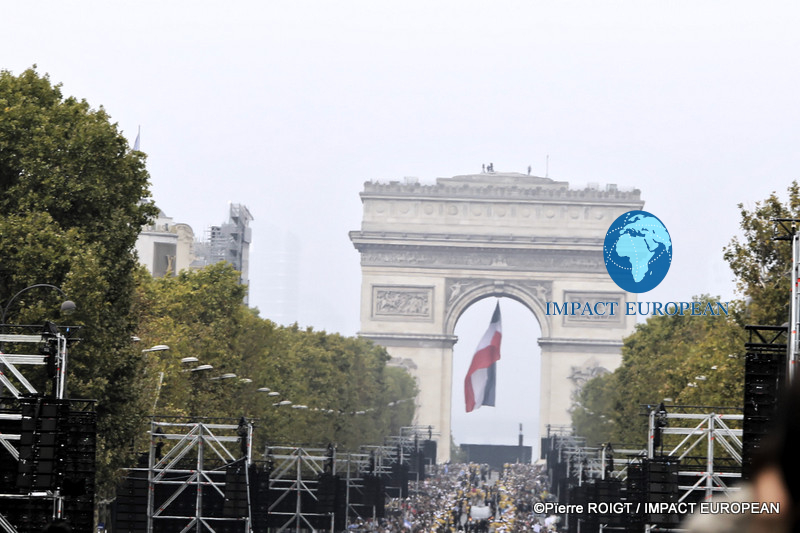
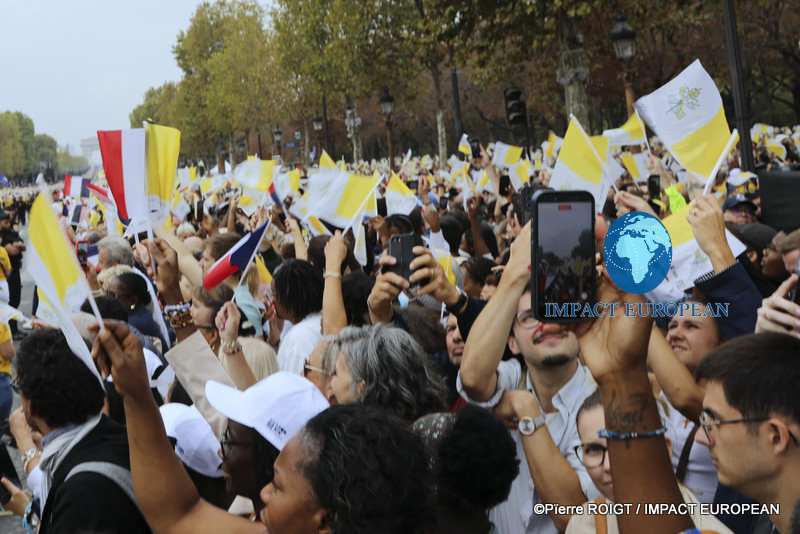
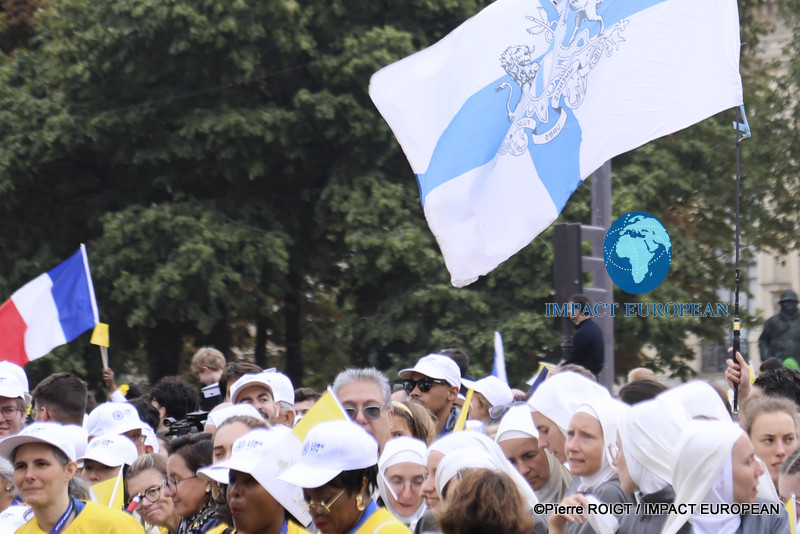
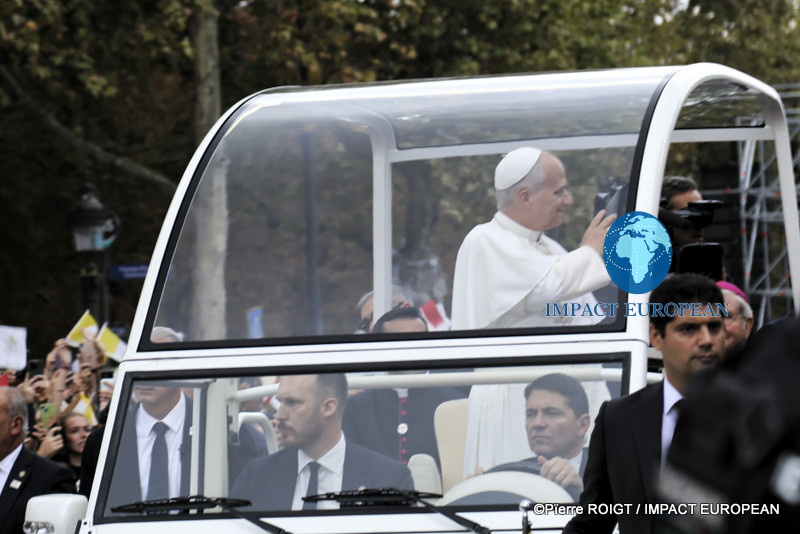
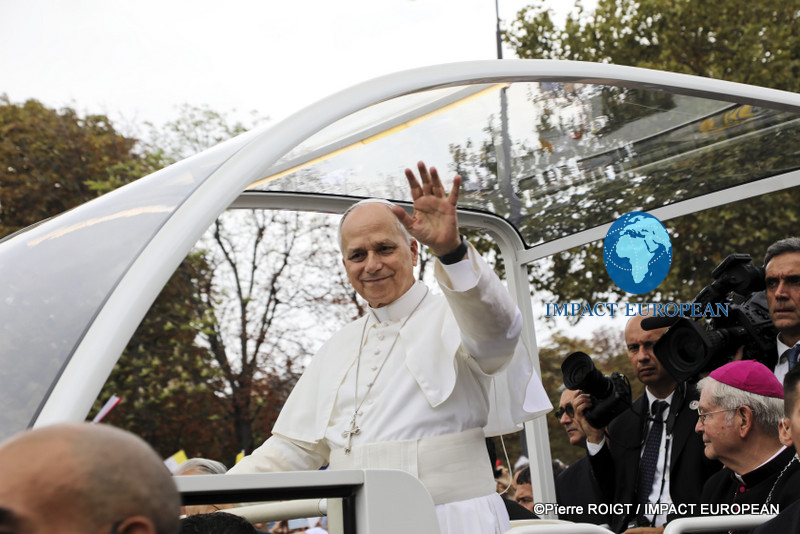
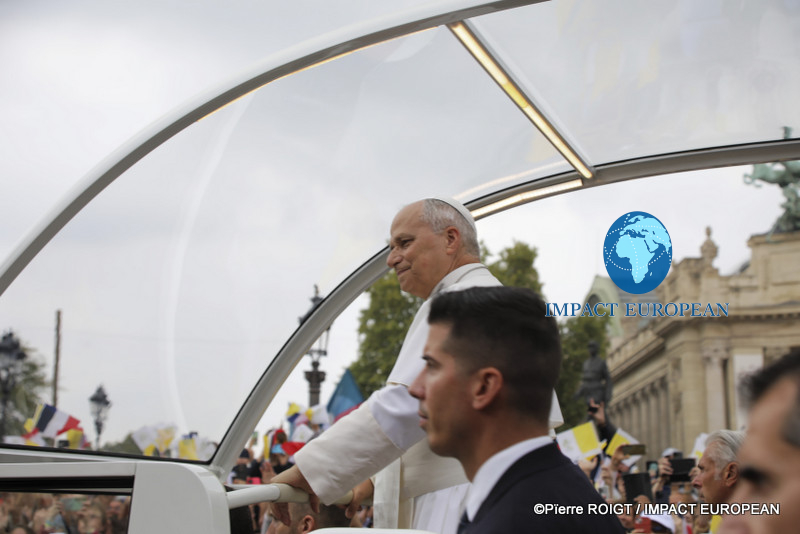
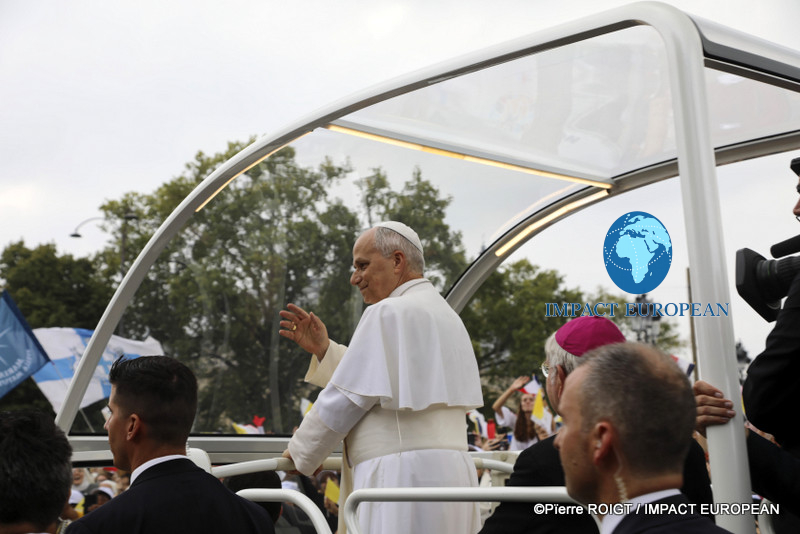
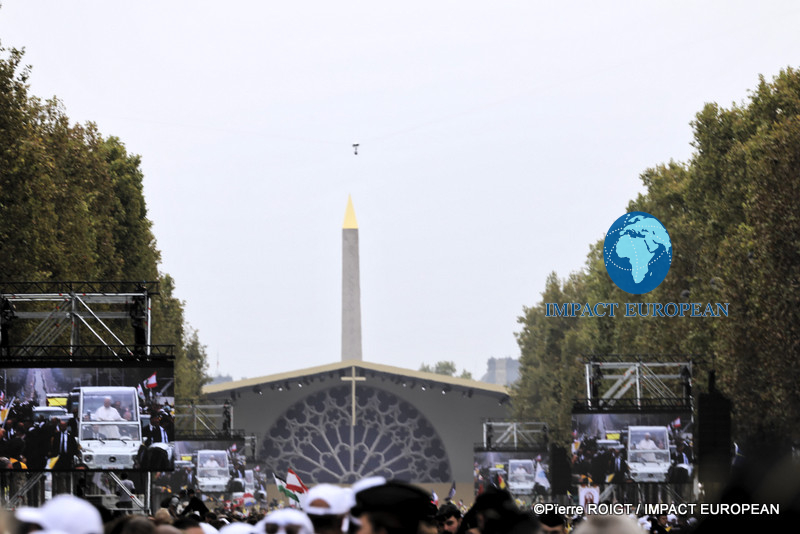
On Saturday, Place de la Concorde and the Champs-Élysées became the setting for the largest celebration of the Paris stage, with approximately 800,000 people gathered across the area.
Before Leo XIV reached the monumental altar, nearly 150 religious dignitaries — including the bishops of France wearing their mitres and several cardinals — took part in the entrance procession and the liturgical service.
The procession gave the gathering an unmistakably national ecclesial dimension: the French episcopate assembled before the Pope in the centre of Paris while hundreds of thousands followed the celebration.
Political and institutional figures were also present.
Prime Minister Sébastien Lecornu, National Assembly President Yaël Braun-Pivet, Senate President Gérard Larcher, former president Nicolas Sarkozy, and political figures including Édouard Philippe, Gabriel Attal, Marine Le Pen and Jordan Bardella were among those attending.
President Emmanuel Macron did not attend the Concorde Mass and was represented by Brigitte Macron.
Yet Leo XIV did not build his homily around the size or prestige of the gathering.
He began with human desire.
Beyond the crowd, a question about meaning
“What are we really looking for in life?”
The question shifted attention away from the spectacle surrounding the Mass.
Leo XIV spoke about the universal desire for happiness, love and fulfilment, while questioning whether material possessions and immediate satisfaction can provide a lasting answer.
The human person, he argued, remains fundamentally a being of desire.
The Pope then introduced one of the defining images of his French journey: water.
Christ was presented as a source from which believers can drink, but the image did not end with individual spiritual fulfilment.
Those who receive are expected to give.
Believers, Leo XIV said, can themselves become wells, springs and rivers for others.
Faith is therefore presented not simply as something privately possessed, but as something whose credibility depends on what it produces in relationships with other people.
That distinction becomes important throughout the rest of the journey.
A new generation raises the question of transmission
The presence of young people in Paris added another dimension.
Tens of thousands filled the Stade de France, while catechumens and recently baptised Christians were also part of the Pope’s Paris meetings.
For a country frequently described through the lens of secularisation, these images created an apparent contrast.
They do not, however, erase the long-term decline in religious practice or the difficulties facing many dioceses.
Instead, they raise a different question: how can a religious tradition be transmitted when belonging to it can no longer be taken for granted?
Leo XIV connected contemporary believers with figures from France’s Christian history, recalling names including Blandina, Pothinus, Irenaeus, Martin of Tours, Francis de Sales, Vincent de Paul, Frédéric Ozanam and Jeanne Jugan.
The point was not simply to celebrate the past.
Their lives were presented as examples of belief becoming service.
That relationship between conviction and responsibility would become much more concrete at the next destination.
Lourdes changes the measure of importance
Only hours after the vast Paris gathering, Leo XIV arrived at the Grotto of Massabielle.
On Sunday, approximately 150,000 pilgrims attended Mass at the sanctuary, together with around 1,000 priests, 150 bishops, about 100 deacons and 1,500 volunteers.
But Lourdes offered a very different measure of significance.
Here, the people who normally risk being pushed to the margins occupied the centre.
The sick set the rhythm.
People living with disabilities, illness and dependence were not peripheral to the event. The organisation of the sanctuary itself required others to adapt to them.
This reverses a common social assumption.
Human value is no longer measured through productivity, physical strength or complete independence.
For Leo XIV, vulnerability becomes a test of how seriously society takes human dignity.
During his meeting with sick people and their caregivers at the Accueil Notre-Dame, the Pope described fragility as a place of encounter rather than something to be hidden.
His message supported care for vulnerable people, medical accompaniment and palliative care.
The implications extend beyond Catholic teaching.
European societies are facing ageing populations, increasing healthcare pressures and difficult debates over dependence, end-of-life decisions and the meaning of autonomy.
Lourdes placed those debates before the image of a person who needs another person.
The Church confronted by its own failures
Speaking about dignity also required the Catholic Church to confront violations committed within its own institutions.
At the end of the Paris Mass, Marie Derain de Vaucresson, founding president of France’s Independent National Authority for Recognition and Reparation, known as INIRR, presented Leo XIV with a report covering five years of work with people subjected to sexual violence within the Church.
She asked the Pope to encourage not only French bishops but episcopal conferences elsewhere and the Vatican to continue strengthening responses to survivors and recognising the violence committed against them.
According to Derain de Vaucresson, Leo XIV replied:
“Yes, it is important.”
The issue continued in Lourdes.
Cardinal Jean-Marc Aveline, president of the French Bishops’ Conference, spoke about the work undertaken by the Church in France to listen to victims, recognise their suffering, strengthen prevention and continue a process that cannot simply be declared complete.
Leo XIV paused before the image known as “the crying child” and also met people who had experienced sexual abuse within the Church.
The sequence created one of the most difficult tests of the message heard throughout the journey.
An institution that speaks about human dignity must also examine the ways in which dignity has been violated within its own structures.
Recognition, justice, reparation and prevention therefore become part of institutional responsibility.
Lourdes reveals the wider challenges facing French Catholicism
The French bishops brought other concerns to the Pope as well.
They included the transmission of faith in a secularised society, poverty and solidarity, migration, families, education, vocations, relations with other Christian communities and religions, ethical questions and the decline of human and financial resources in some dioceses.
At the same time, the bishops pointed to growing numbers of young adults seeking Christian initiation.
These apparently contradictory developments resist a simple narrative of either religious decline or religious revival.
France is experiencing both institutional weakening in some areas and new forms of religious engagement in others.
The challenge is therefore not merely to attract people.
It is to accompany them after the moment of enthusiasm has passed.
Before leaving Lourdes, Leo XIV called on pilgrims to return home as “missionaries of hope.”
The next stage would test how far that hope could extend beyond Catholicism itself.
Metz brings different religions to the same table
On September 28, the Pope arrived in Metz.
The setting mattered.
Lorraine has repeatedly experienced shifting borders, war, occupation and reconciliation. Metz therefore offered a historical landscape in which questions of religion, nationality and peace could not easily be separated from European history.
The morning interreligious meeting brought together Christian Krieger, president of the Protestant Federation of France; Cardinal Jean-Marc Aveline, president of the French Bishops’ Conference; Metropolitan Dimitrios, president of the Assembly of Orthodox Bishops of France; Haïm Korsia, Chief Rabbi of France; Antony Boussemart, co-president of the Buddhist Union of France; and Chems-Eddine Hafiz, rector of the Grand Mosque of Paris.
They represented different beliefs, histories and communities.
The objective was not to eliminate those differences.
It was to determine what responsibility religious traditions share when violence, discrimination and hatred threaten society.
No religious truth can justify hatred
The Metz Appeal placed that responsibility into words.
Its central declaration is unequivocal:
“The name of God, no more than any religious truth or spiritual tradition, can ever be invoked to justify violence and hatred.”
The document addresses war, attacks on international and humanitarian law, inequality, environmental fragility, discrimination and technological transformations affecting contemporary societies.
Peace, in this framework, cannot simply mean the absence of armed conflict.
It requires justice, respect for human dignity, intergenerational solidarity and care for the common home.
The religious leaders committed themselves to three concrete directions: maintaining demanding dialogue, educating younger generations in mutual knowledge, and standing together even in adversity in defence of justice and peace.
Leo XIV developed the same idea by calling on religions to help “disarm hearts and words.”
He also described religious traditions as “guardians of life.”
After the living water of Paris and the vulnerability encountered in Lourdes, life had become a shared responsibility across religious boundaries.
From religious dialogue to Europe’s political memory
The next meeting in Metz moved from interreligious dialogue to European history.
Its title was explicit:
“At the Roots of Europe for Peace and Unity.”
Cardinal Aveline had suggested Lorraine when possible destinations for the final stage of the journey were being discussed.
Leo XIV’s reported response was concise:
“Metz, because of Europe!”
The choice was deeply symbolic.
This is a region where war repeatedly redrew borders and where Franco-German confrontation left lasting scars.
It is also closely associated with Robert Schuman, one of the major figures in the post-war process of European integration.
Aveline also evoked Konrad Adenauer and Alcide De Gasperi, whose political generation sought to transform the devastation of the Second World War into structures of cooperation.
President Emmanuel Macron participated in the European meeting and later attended the final Mass at Saint-Étienne Cathedral.
Politics and religion remained distinct, but the historical question confronting both was similar: what prevents yesterday’s enemy from becoming tomorrow’s enemy again?
Europe was built on the possibility of reconciliation
The answer offered by Lorraine is historical rather than theoretical.
France and Germany fought repeated wars.
Their reconciliation did not erase those conflicts, their victims or the interests separating the two countries.
It changed the political consequences drawn from that history.
European integration grew partly from the conviction that economic, legal and political cooperation could make another cycle of continental conflict more difficult.
In 2026, that history carries renewed weight.
War has returned to the European continent, international law is under pressure, and power politics once again challenges institutions created to manage conflict through rules and negotiation.
As Cardinal Aveline put it:
“Here in Metz, we know the price of war.”
The question facing Europe is therefore not whether it remembers its past.
It is what it chooses to do with that memory.
Peace requires more than refusing war
The final Mass of the journey took place in Metz’s Saint-Étienne Cathedral.
Leo XIV used three images: the desert, the garden and the house.
The desert strips life back to what is essential.
The garden represents cultivation, fertility and renewal.
The house represents the difficult task of living together.
The Pope argued that peace, although understood in Christian belief as a gift from God, still requires a human response and shared effort.
He contrasted reconciliation with a culture of confrontation.
One of the strongest passages of the homily directly challenged the idea that refusing compromise is necessarily a sign of strength:
“It is not true that the person who never gives way is stronger than the one who seeks reconciliation. It is not true that the person who walks away and slams the door is stronger than the one who accepts the effort of walking together.”
In Lorraine, the words carried historical resonance.
Reconciliation is not presented as forgetting injustice.
Nor does forgiveness remove the need for law.
Its purpose is to prevent one injury from automatically becoming the justification for the next.
From a spring in Paris to a beacon in Metz
At the end of the journey, Leo XIV called Metz to become “more than ever a beacon of hope for this country, for Europe and for the world.”
The image completed a movement that had begun in Paris.
A spring gives life.
At Lourdes, the value of that life was tested through vulnerability and suffering.
The Metz Appeal then offered a “compass of hope” through dialogue.
Finally, the
pointed beyond France toward Europe and the wider world.
The symbolism should not obscure reality.
Religious dialogue does not end war. Recognition does not undo sexual abuse. A large youth gathering does not reverse secularisation. The memory of Franco-German reconciliation does not guarantee Europe’s future. Forgiveness cannot replace justice or international law.
But the four days in France connected these realities through a common principle: responsibility for the other.
Paris asked whether faith can become something that is given rather than merely possessed.
Lourdes asked how society treats people whose vulnerability makes them dependent on others, while forcing the Church to confront people harmed within its own institutions.
Metz asked whether religions can reject hatred together and whether Europe can continue drawing political consequences from the memory of its wars.
The crowds will disappear. The temporary altars will be dismantled. The Pope will return to Rome.
What remains is a harder question for France and for Europe:
Can hope still become a form of responsibility when societies are divided, institutions are wounded and peace can no longer be taken for granted?
©2026 IMPACT EUROPEAN – All rights reserved
Views: 0
More Stories
Route du Rhum 2026: From the Paris Stage to the Atlantic, a Race Between Ocean Passion and Planetary Urgency
Pope Leo XIV in France: A Journey from the Presidential Welcome to Encounters with the Faithful
Colomiers run in 10 tries in 66-21 rout of Dax