

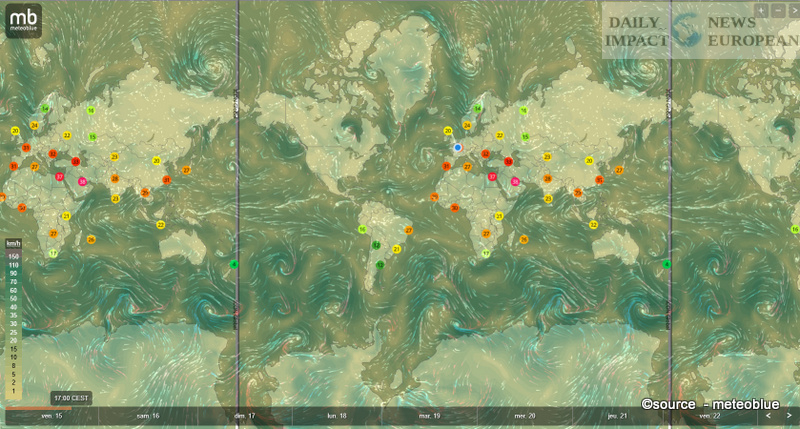
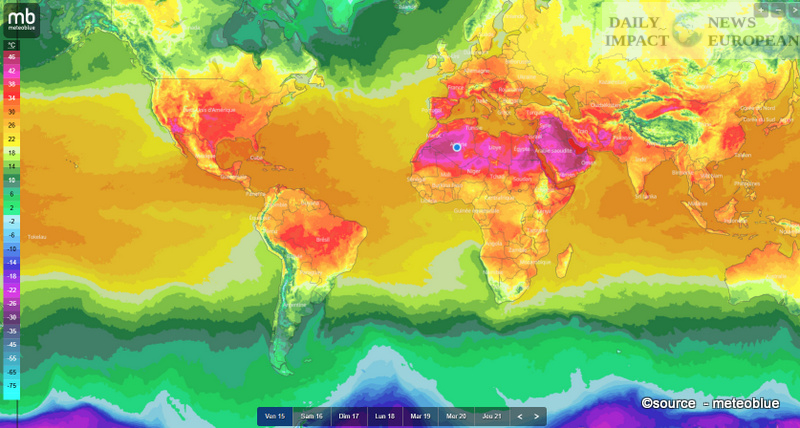
Global temperatures have reached record levels for this period, caused by a hot air mass coming from Africa, according to meteorologists.
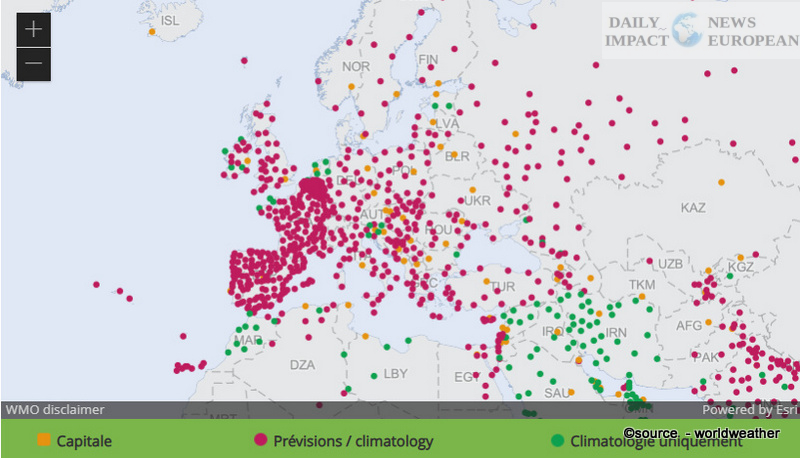
Spain is experiencing a heat wave, as is France. Some French cities have recorded temperatures of up to 36, or even 40 °C, especially in the south and east of France.
The northeastern United States is also facing a record heat wave for this time of year.
Meanwhile, some regions of India and Pakistan have been experiencing drought since March, considered the hottest month in India in the last century.
Moreover, meteorologists are not predicting good news, forecasting new heat records for the end of the month, following the 51 °C recorded in Pakistan.
Temperatures above 35 °C in 20 of the world’s largest capitals have increased by 52% over the past three decades, according to an analysis by a group of experts.
Over 300 million people living in the 20 most populated capitals are exposed to rising temperatures. Capitals such as New Delhi, Dhaka, and Manila have all experienced intense heat waves, resulting in increased heat-related deaths.
An analysis by the International Institute for Environment and Development quantified the increased danger of extreme heat in some of the world’s largest urban centers. Based on surface temperatures recorded by airport weather stations, scientists found that between 2014 and 2023, there were nearly 6,500 cumulative days, or cases, in which one of the 20 cities reached temperatures of 35 °C or more. This compares to 4,755 such days recorded between 1994 and 2033.
Scientists say that heat waves are felt depending on several factors. “We know that heat is not felt uniformly across all cities,” said Tucker Landesman, a researcher at IIED. “Heat accumulations are more likely in certain types of neighborhoods and commercial areas. This is related to inequalities and the way we design buildings and public infrastructure,” he added.
Additionally, Jakarta, the capital of Indonesia, is declared the capital recording the highest increase in the number of extreme temperature days. Thermometers exceeded 35 °C, rising from 28 days between 1994 and 2003 to 167 days over the past decade.
Norway, Sweden, and Finland have historically experienced cool climates but have recently been hit by high temperatures, with a record of 22 days above 30 °C in Finland.
Sweden also experienced 10 consecutive days of “tropical nights,” where temperatures do not fall below 20 °C.
Much of the Northern Hemisphere has been affected by heat waves in recent weeks. These countries include the United Kingdom, Spain, and Croatia, where wildfire damage is nearly double the 20-year average. Major problems have also been reported outside Europe, notably in the United States, Japan, and South Korea. Scientists are convinced that the climate crisis has intensified these extreme weather events.
Global warming, caused by the burning of fossil fuels, has increased the likelihood of heat waves by at least ten times and caused a 2 °C rise in temperatures, according to scientists. Some meteorological data and climate models used in their analysis indicate that heat waves would be impossible without human-caused climate change.
This week, northern Vietnam is experiencing record temperatures for August. The thermometer reached 40.3 °C, a historical record for this time of year. In the main streets of the city, the heat is felt with an increase of 2 to 5 °C.
Week after week, the situation is worsening in Iran. Now, in many provincial cities, as well as some districts of Tehran, there are two-hour power cuts twice a day. The situation is also dramatic regarding drinking water.
This situation is caused by an unprecedented drought for five years, which has worsened this year. In many industrial areas, electricity is cut off for several consecutive days, affecting production in many sectors.
In Dakar, the heat is becoming suffocating. Between 1986 and 2023, Senegalese capitals have grown at a frantic pace. Comparing aerial maps of recent decades, urban expansion, population densification, and massive use of materials such as concrete and asphalt have turned the city into a huge heat trap. Road infrastructure stores heat during the day and releases it at night, creating heat islands where temperatures remain abnormally high.
To mitigate this phenomenon, experts recommend returning to vegetation. More trees to cool the air and reduce temperature. This recommendation is echoed by a petition launched a few weeks ago, already signed by more than 3,000 people, proposing to transform the Geille camp – a former French military base returned to Senegal in June – into a large urban park in the heart of Dakar.
Since Friday, August 8, France is experiencing a sudden second heat wave of the summer. The heatwave, particularly affecting the Southwest, is expected to last more than ten days and be of remarkable intensity. Six departments have been placed on red alert, and several temperature records have been broken.
In France, 70 departments were on orange alert on Friday. The heatwave is expected to continue until Tuesday.
On Friday, August 15, with 70 departments under orange vigilance by Météo-France, it is the eighth day of the heatwave affecting the country and southern Europe.
Temperatures are expected to reach 40 °C again – occasionally more – in the Southwest, according to the latest bulletin from the institute, which forecasts very high temperatures over the Mediterranean arc. With 35 °C forecasted, the heatwave is also spreading to Brittany, previously spared, while decreasing in the north, classified as green.
Île-de-France is no longer under orange alert since 6 a.m. Friday, and the alert level is also lifted for Loiret, Yonne, Aube, and Haute-Marne from 10 p.m. Conversely, temperatures are rising in Finistère, Morbihan, Loire-Atlantique, Maine-et-Loire, Deux-Sèvres, Vienne, Indre-et-Loire, Loir-et-Cher, and Pyrénées-Atlantiques, which will move to orange by Wednesday noon.
The risk of fires will be even higher in the coming days in the South and Center-West, due to safety and wind conditions.
Italy is experiencing a new heatwave with temperatures reaching 40 °C. In several cities, temperatures could reach 40 degrees Celsius or more. Meteorologists observed 40 degrees in Florence on Saturday. In Bolzano, it will be 38 degrees. Rome reaches 36 degrees and Naples 35 degrees. The regions of Tuscany, Emilia-Romagna, and the area around Rome will be particularly affected by the heat.
The heatwave is expected to last at least a week, until after the Ferragosto holiday (Assumption Day) on August 15, traditionally considered the peak of summer in Italy. Authorities have issued heat alerts in several cities and advised the population to avoid any physical exertion, especially the elderly and those with health problems.
Red heat alerts have been triggered in Italy, France, Portugal, the Balkans, and Spain, where the National Meteorological Agency announced that the heatwave would likely continue until Monday.
In Portugal, the hardest-hit country by wildfires, bells rang in the morning to give the alert in the village of Trancoso, site of the most worrying fire, while a thick cloud of smoke rose in the distance. About 700 firefighters and airmen are on site, but residents are mobilized and water their surroundings using hoses in hopes of stopping the flames.
Greece has called on the European Mechanism for fighting forest fires to tackle new fire outbreaks. The most dangerous are on the island of Zakynthos in the Ionian Sea, in Vonitsa and Preveza, cities in western continental Greece, as well as in the Achaia department in the western Peloponnese, where 20 preventive evacuations were carried out.
In the southeast of the continent, the Balkans are also on the front line, whether in Albania, where several hundred firefighters and soldiers fight fires, Montenegro, or Croatia.
Temperatures in the Balkans range between 35 and 42 degrees Celsius.
©2025 – IMPACT EUROPEAN

Views: 0
More Stories
Alzheimer Research Foundation Gala in Paris: when music and solidarity unite for global research
Foire du Trône: inside Europe’s largest fairground in Paris
Pro-Palestinian demonstrations held across France to mark Land Day