
General Exhibition: The New Life of Art in Paris
There are places you enter without really knowing what you will find.
And then there are those that, from the very first second, grab you, transform you, and make you want to see everything differently.
The Fondation Cartier pour l’art contemporain, established since October 2025 at 2 Place du Palais-Royal, belongs to this second category.
A place you don’t just visit: you experience it.
A New Heart Beats in the Center of Paris
Facing the Louvre, between the arcades of Rue de Rivoli and the trees of the Palais-Royal, rises a building of pale stone, discreet yet fascinating.
At first glance, nothing reveals what it houses: a gentle revolution, a space where architecture and art merge into one.
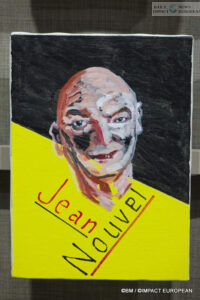
It is Jean Nouvel, the renowned architect of the Louvre Abu Dhabi, the Philharmonie de Paris, and the Institut du Monde Arabe, who reinvented this iconic site.
Behind the 1855 Haussmannian façade — which was successively the Grand Hôtel du Louvre, the Grands Magasins du Louvre, and the Louvre des Antiquaires — he designed an architecture in motion, almost alive.
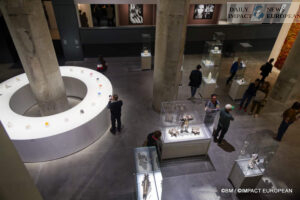
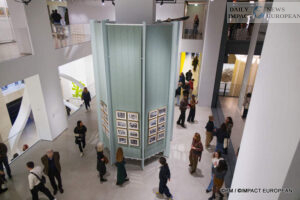
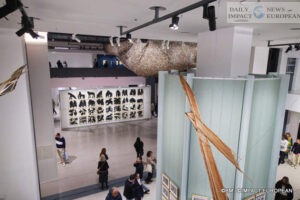
Five gigantic steel platforms, mobile like theater stages, rise and descend according to the needs of the exhibitions.
Lights change, volumes breathe, the building adapts, opens, and closes.
It is no longer a museum: it is a living organism, capable of reinventing itself with each project.
Art here becomes a physical experience, a dialogue between space, light, and emotion.
Jean Nouvel calls it « a shelter for the unpredictable »: a free, flexible place open to surprise, where artists can imagine anything.
“Art must have the possibility to move, to transform, to occupy the city,” he said when presenting the project.
And this is exactly what he achieved: a building that, while respecting history, speaks resolutely to the present.
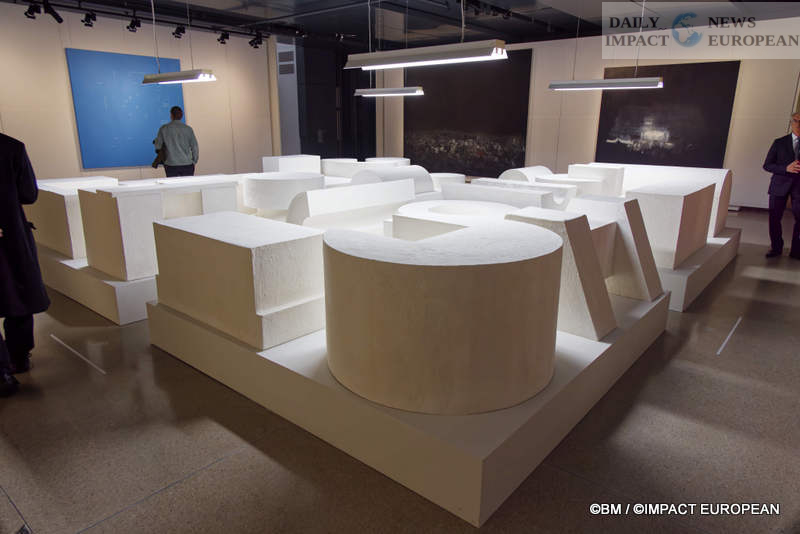
A Manifesto Exhibition: “Exposition Générale”
To inaugurate this cultural vessel, the Fondation Cartier did not choose a typical exhibition.
It presents a manifesto: “Exposition Générale”, on view until August 23, 2026.
The title pays homage to a time when, in this very place, the Grands Magasins du Louvre organized major exhibitions of new products.
But this time, it’s no longer products on display: it is visions of the world, fragments of beauty, cries, dreams, hopes.
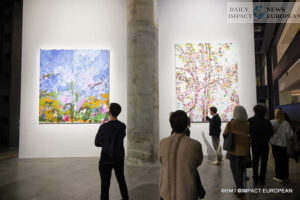
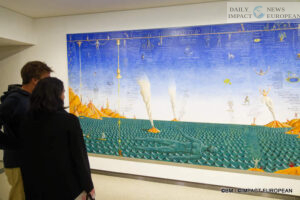
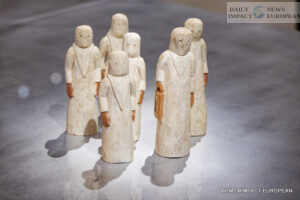
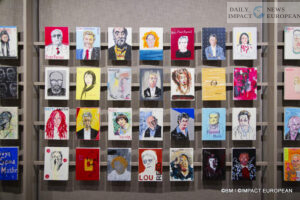
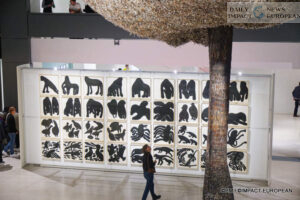
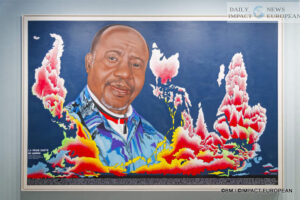
Under the direction of Grazia Quaroni and Béatrice Grenier, the Fondation brings together over 600 works by more than 100 artists from around the world — some famous, others emerging, all united by a common desire: to make the invisible visible.
It is a journey through forty years of contemporary creation, from 1984 to today, but also an immersion into the very spirit of the Fondation Cartier: freedom, openness, curiosity.
Architectural Machines — Imagined Cities
From the very entrance, the tone is set.
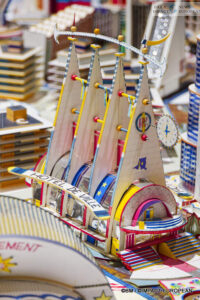
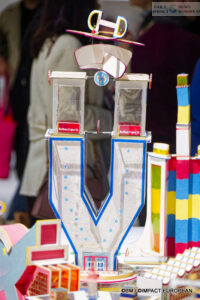
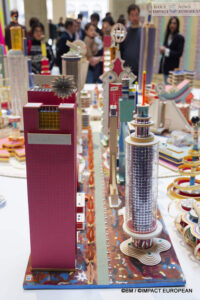
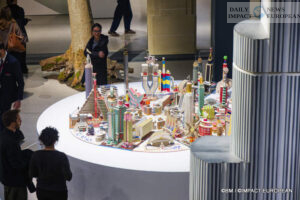
Under a vast glass canopy, the first platform hosts the Architectural Machines section.
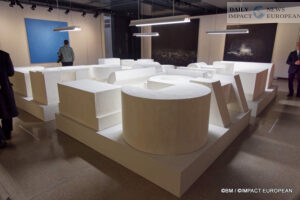
Here, architecture becomes an art of imagination, a play with dimensions, scales, and materials.
Visitors discover Alessandro Mendini’s Little Cathedral, a small sparkling church made of glass, metal, and mosaic.
It emits a subtle fragrance and colorful reflections that dance on the floor, like a silent prayer.
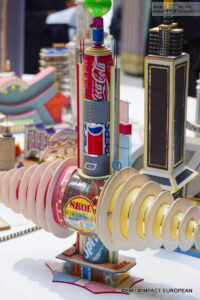
Nearby, models by Bodys Isek Kingelez, the late Congolese artist (1956–2015), explode with color and whimsy: futuristic cities made of cardboard and plastic, yet full of hope.
They tell a different vision of the world: one of joyful, human, borderless urbanism.
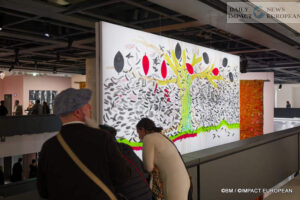
Then there are drawings by Mamadou Cissé, a self-taught Senegalese artist, who handcrafts vertiginous, poetic dream megacities.
Suspended cities connected by invisible bridges, architectures as utopias.
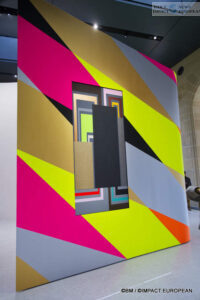
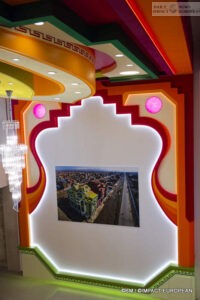
This section also features architects and designers like Junya Ishigami and Freddy Mamani, whose Salón de Eventos — a colorful ballroom visible from Rue de Rivoli — brings Bolivian rhythm to the heart of Paris.
It’s a joyful, energetic cultural shock.
And above all this, the platforms move slowly, as if the architecture itself were dancing.
Being Nature — Art and Life in Dialogue
Descending a level, the light changes, silence sets in, and visitors enter the Being Nature section.
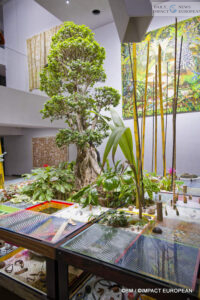
Here, concrete gives way to the breath of life.
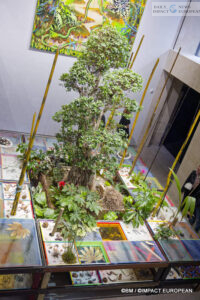
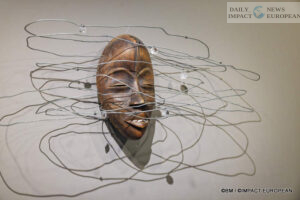
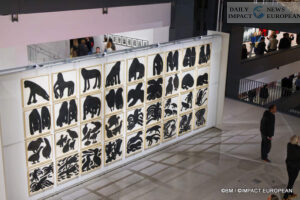
Videos, photographs, sounds, and sculptures narrate the connection between humans and nature.
Works by Brazilian Yanomami artists converse with those of Graciela Iturbide, Sally Gabori, or Raymond Depardon.
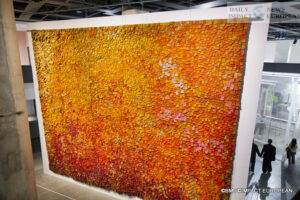
Trees, rivers, spirits, and faces mingle in a soothing, almost shamanic atmosphere.
One hears the wind, birds, and rain.
The exhibition no longer just shows: it makes you feel.
It reminds us that contemporary art can be a way to listen to the world, to slow down, to understand differently.
For a young visitor, it’s a revelation: nature is not a distant idea. It is here, alive, present, fragile, beautiful.
Art becomes a mirror of this connection we must reinvent.
Making Things — The Art of Doing
Lower down, another universe opens: Making Things.
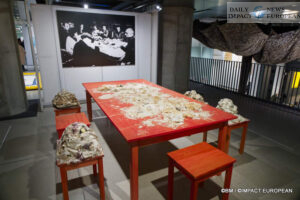
It is a hymn to material, gesture, and craftsmanship.
In a world dominated by the virtual, this section reminds us of the beauty of the tangible.
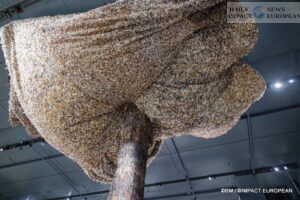
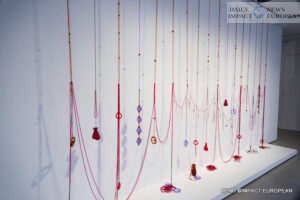
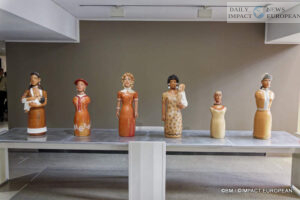
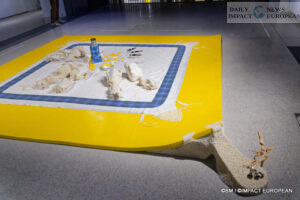
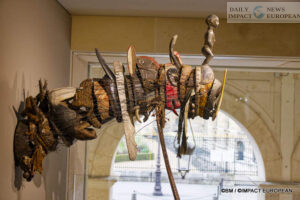
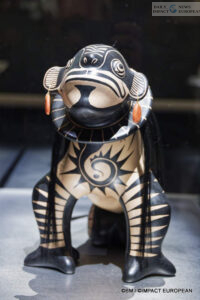
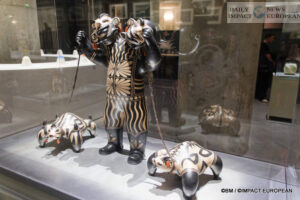
Ceramics, sculptures, and installations show the power of the artist’s hand.
Works by Alev Ebüzziya Siesbye, Gustavo Pérez, and Solange Pessoa demonstrate that creation, before being conceptual, is first and foremost human.
Artists use clay, metal, glass, fabric, but also unexpected materials: sand, bone, fibers, dust.
Each work speaks of time, patience, and know-how.
It is not nostalgia for the past; it is a reinvention of gesture.
This section touches a sensitive chord: it connects the creator to the craftsman, the dream to the hand.
For a young person, it’s a powerful message: creating is possible, with your hands, ideas, and boldness.
A Real World — Where Art and Science Meet
Finally, the last major section: A Real World.
Here, the Fondation Cartier looks to the future.
Artists collaborate with scientists, engineers, and poets to imagine what the world could become.
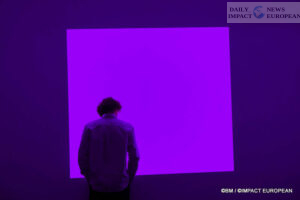
James Turrell’s light installations stand alongside David Lynch’s videos or Sarah Sze’s technological works.
Science becomes poetic matter.
Screens, sounds, and projections envelop the visitor.
One moves from a cosmic universe to a microscopic dive, from a dream of space to reflections on climate or digital data.
It is spectacular, yet intimate.
Each work asks a simple question: what do we want to become?
Art here is not an answer but an invitation to reflect, doubt, and hope.
A Place to Learn, Create, Share
Around the exhibitions, the Fondation Cartier has created new spaces designed for the public.
There is La Manufacture, a 300 m² educational workshop, where one learns to create through gesture, experiment with materials, and understand art differently.
Workshops for all ages, where hands and imagination meet.
An auditorium — the Studio Marie-Claude Beaud — hosts concerts, performances, and debates.
A bookstore brings together rare books and artist editions, and Le Petit Café, bathed in light, invites visitors to extend their visit over coffee or conversation.
Everything is designed for the place to become alive, a space for encounters and ideas.
More than a Museum: An Experience
What strikes at the Fondation Cartier is that everything is in motion.
Light changes with the hours of the day, platforms rise and disappear, artworks respond to each other.
It is a place in perpetual metamorphosis, like creation itself.
Visitors wander, stop, look up, listen.
Some linger in front of a video, others are captivated by a play of shadows.
Nothing is imposed; everything is free.
And perhaps that is the strength of this place: it gives everyone back the right to see in their own way.
Art is no longer knowledge reserved for a few; it becomes a shared adventure.
Art for Tomorrow: An Invitation to Youth
For an 18-year-old, stepping into the Fondation Cartier is entering another world.
A world where art doesn’t lecture but invites dreaming, creating, and thinking differently.
It is not a silent museum: it is a vibrant space, a mirror of today’s world.
Here, contemporary art is neither cold nor abstract — it speaks of the planet, the city, emotions, technology, humanity.
It questions who we are and what we could become.
The Fondation Cartier at Palais-Royal is not just an exhibition space: it is an experience of freedom.
An open door to the future, in a Paris that continues to invent, surprise, and dream.
Information:
Fondation Cartier pour l’art contemporain
2 Place du Palais-Royal – 75001 Paris
Exposition Générale: October 25, 2025 – August 23, 2026
fondationcartier.com
Next Exhibition (Autumn 2026): “The Time of Harvests, Ibrahim Mahama”
©2025 – IMPACT EUROPEAN































Views: 0
More Stories
Salon international de l’agriculture 2026: A Cattle-Free Edition Under Pressure
Paris Agricultural Show Opens Without Cattle Amid Tensions
51st César Awards: A Night of French Cinema and Parisian Elegance