

Geopolitical and strategic analysis based on the positions of Latvian President Edgars Rinkēvičs
The End of the Peripheral Illusion
Since the launch of Russia’s war of aggression against Ukraine, the European Union has been forced to confront a geopolitical reality it long sought to keep at arm’s length: the security of the European continent can no longer be separated from its eastern border. Eastern Europe, long perceived as a political, economic and strategic periphery, has become a central arena for the projection of international power dynamics.
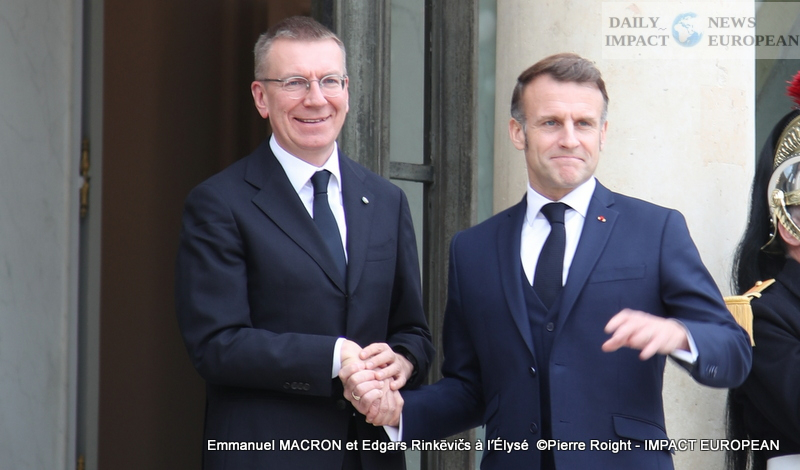
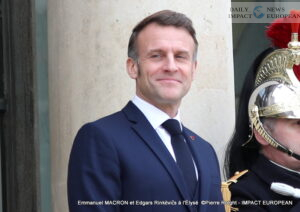
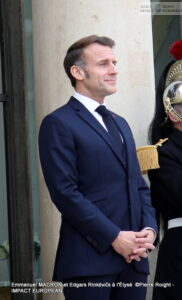
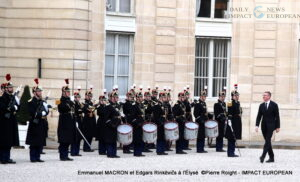
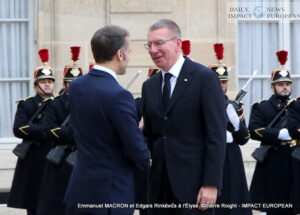
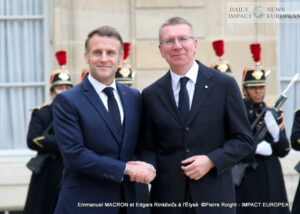
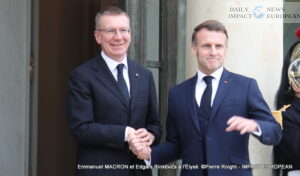
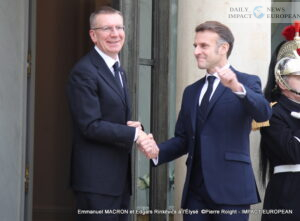
The working visit of the President of the Republic of Latvia, Edgars Rinkēvičs, to Paris on 15 December is fully embedded in this strategic shift. Through his meetings with French President Emmanuel Macron, Senate President Gérard Larcher and National Assembly President Yaël Braun-Pivet, the Latvian head of state articulated a coherent and structured vision of Europe’s current challenges, linking military security, the EU budget, strategic infrastructure and economic competitiveness.
Far from being a purely diplomatic exercise, the visit highlights how Eastern European states now view the future of the European Union: no longer as a post-historical space defined solely by economic integration, but as a geopolitical actor compelled to think seriously about its own strategic survival.
NATO’s Eastern Flank: From Geographic Margin to Strategic Front Line
1. A Lasting Reconfiguration of European Security
For Latvia, as for the other Baltic states, the war in Ukraine has confirmed a long-standing intuition: European stability can no longer be taken for granted. Geographic proximity to Russia transforms every development in the Ukrainian conflict into a direct national security concern.
In this context, the gratitude expressed by Edgars Rinkēvičs towards France goes far beyond diplomatic courtesy. It reflects strategic recognition of France’s commitment to NATO’s eastern flank, notably through:
-
its participation in the Baltic Air Policing mission,
-
its engagement within the NATO battlegroup in Estonia,
-
and its leadership in sustaining the transatlantic dialogue.
From Riga’s perspective, France’s military presence anchors Baltic security firmly within a collective European framework, reducing the risk of strategic isolation for frontline states.
2. Deterrence as the Foundation of Stability
The deterrence logic implicitly defended by Latvia is grounded in a pragmatic reading of power relations. The visible and credible presence of allied forces aims to limit Russia’s room for manoeuvre, by making any escalation politically and militarily costly.
Unlike some Western approaches still shaped by crisis-management thinking, Eastern European states favour a strategy of prevention through deterrence, viewed as the only reliable guarantee of stability.
Ukraine: A War Structuring the European Order
1. An Existential Reading of the Conflict
In his conversation with President Emmanuel Macron, Edgars Rinkēvičs unequivocally called for the continuation of financial and military assistance to Ukraine, as well as sustained pressure on Russia.
This position reflects a conviction widely shared in Riga: the war in Ukraine constitutes a decisive test for the European security order. A Russian victory, or even a frozen conflict imposed on Kyiv from a position of weakness, would set a dangerous precedent affecting all states exposed to Russian pressure.
For Latvia, supporting Ukraine therefore amounts to indirectly safeguarding its own national security.
2. A Persistent East–West Perception Gap
This interpretation contrasts with debates in certain EU member states where the war is sometimes framed primarily in terms of economic costs or domestic political consequences.
The Latvian position highlights a persistent East–West perception gap: while Western Europe may still treat the conflict as distant, Eastern Europe experiences it as an immediate and enduring threat.
The EU Budget as a Strategic Instrument
1. The Multiannual Financial Framework and Geopolitical Reality
A central focus of the Paris discussions was the EU’s next Multiannual Financial Framework (MFF). For Edgars Rinkēvičs, the European budget must reflect current geopolitical realities.
Security and defence can no longer be treated as secondary policy areas. They must be placed at the core of European budgetary planning, alongside cohesion and agriculture.
2. Rail Baltica: Civilian Infrastructure, Military Utility
The Rail Baltica project exemplifies this evolution. Officially designed to integrate the Baltic states into the European rail network, it also serves as a dual-use infrastructure essential for military mobility.
From Latvia’s perspective, EU funding for Rail Baltica is not a narrow national demand, but a collective strategic necessity. A Europe unable to move troops and equipment rapidly across its eastern territory would remain structurally vulnerable.
Security, Cohesion and Agriculture: A Strategic Balance
Edgars Rinkēvičs stressed the need to preserve a balance between new security priorities and traditional EU policies.
Cohesion policy and agriculture are central to the economic and social resilience of regions most affected by the indirect consequences of the war in Ukraine, including:
-
rising energy costs,
-
logistical disruptions,
-
and pressure on agricultural markets.
For Latvia, weakening these policies would undermine the EU’s internal cohesion and risk fuelling political tensions exploitable by external actors.
European Competitiveness and the East–West Economic Divide
1. An Inclusive Vision of Competitiveness
Beyond security issues, the Latvian president advocated for a resilient, digital and competitive European Union.
Strategic autonomy, he argued, cannot exist without a strong economic base capable of sustaining innovation, research and future technologies.
2. Cooperation Between Large and Small Economies
Latvia calls for deeper cooperation between large European economies, such as France, and smaller member states. Smaller countries often possess highly specialised technological capabilities that can strengthen Europe’s overall competitiveness.
Such cooperation, however, requires a reduction in the regulatory and administrative burden on businesses—particularly SMEs and start-ups, which are often disadvantaged compared to large corporations.
Regulatory Simplification and Technological Innovation
Edgars Rinkēvičs emphasised the need for the EU to evolve towards a next-generation technological economy, built on:
-
research and development,
-
innovation,
-
digitalisation,
-
and future-oriented technologies.
For Eastern European states, innovation is a key convergence tool, enabling economic catch-up while reinforcing European technological sovereignty.
France Seen from Eastern Europe
France occupies a particular place in Latvia’s strategic outlook. As a major European military power and a central EU actor, it is viewed as a pillar of Europe’s strategic balance.
France’s economic resilience is regarded as a collective European interest, both for the stability of the internal market and for Europe’s credibility on the global stage.
A More Strategic, Yet Still Incomplete Europe
The visit of Edgars Rinkēvičs to Paris reveals a paradoxical dynamic:
the European Union is moving towards greater strategic awareness, yet remains constrained by internal divergences over pace, funding and burden-sharing.
Eastern Europe, long seen primarily as a beneficiary of European solidarity, is now asserting itself as a driver of strategic reflection, calling for a more realistic, coherent and better-prepared Union.
Eastern Europe as a Mirror of Europe’s Future
Through the positions expressed by Latvian President Edgars Rinkēvičs, Eastern Europe emerges not as a periphery to be protected, but as a mirror reflecting both the vulnerabilities and the potential of the European Union.
Security, economy, cohesion and competitiveness can no longer be addressed separately. They now form a single, indivisible strategic framework, whose balance will determine whether the European Union can assert itself as a credible actor in an increasingly unstable world.
©2025 – IMPACT EUROPEAN








Views: 0
More Stories
Alzheimer Research Foundation Gala in Paris: when music and solidarity unite for global research
Foire du Trône: inside Europe’s largest fairground in Paris
Pro-Palestinian demonstrations held across France to mark Land Day