


Berlin, the Western World’s Center of Gravity
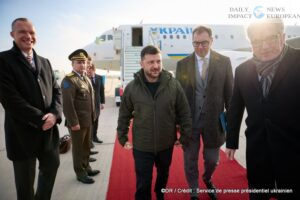
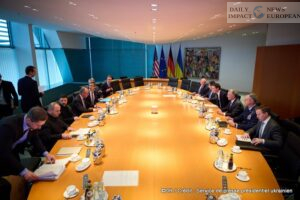
In just a few days, Berlin has established itself as the nerve center of global diplomacy. Rarely since the end of the Cold War has the German capital brought together such a dense concentration of European leaders, transatlantic officials, and key strategic actors around a single issue: the war in Ukraine and the political, military, and economic conditions for a lasting peace.
As the conflict triggered by Russia’s February 2022 invasion enters its fourth year, the limits of a prolonged war of attrition are becoming increasingly clear. Ukraine continues to resist militarily, Russia presses on with its offensives, but Europe, the United States, and their allies are now seeking to structure a credible exit from the war without abandoning fundamental principles of sovereignty, collective security, and continental stability.
Berlin did not host just a diplomatic meeting. It was the stage for a strategic turning point, where immediate military stakes, long-term security guarantees, and post-war economic prospects intertwined.
A War That Has Become Systemic
When Vladimir Putin ordered the full-scale invasion of Ukraine in February 2022, the Kremlin anticipated a quick victory. Three years later, the conflict has evolved into a high-intensity war with global repercussions: energy disruptions, inflation, shifting alliances, increased militarization of Eastern Europe, and the enduring return of conventional deterrence on the continent.
Supported by its Western partners, Ukraine has demonstrated remarkable military resilience. However, this resistance comes at a colossal human, economic, and industrial cost. Russia, meanwhile, has committed an increasing share of its productive and energy capacities to the war effort, at the price of greater dependence on its war economy and non-Western partners.
Military Losses: Between Messaging and Documented Reality
The Ukrainian General Staff publishes daily figures detailing losses inflicted on the Russian army. While indicative, these numbers must be analyzed cautiously. In any conflict, information is also a weapon.
Independent analyses are therefore particularly important. The Oryx group, which specializes in visually confirmed military losses, reported that as of October 1, 2025, Russia had lost at least 22,909 military units confirmed visually since the beginning of the invasion.
This figure, which only accounts for losses documented through verified images or videos, provides an idea of the material scale of the conflict. It does not reflect all human losses, nor damaged but repaired equipment, yet it remains a credible indicator of the intensity of the war.
A Technological Breakthrough: Naval Operations and Strategic Signals
On December 15, Ukraine announced what Kiev described as an “unprecedented” operation: the presumed destruction of a Russian submarine by a Ukrainian naval drone in the port of Novorossiysk in the Black Sea. Russian authorities did not immediately confirm these claims.
According to Ukrainian services, the operation involved the SBU and the Ukrainian navy. If confirmed, it would illustrate the evolution of asymmetric capabilities in the conflict, without by itself altering the overall naval balance in the Black Sea.
Military analysts emphasize that actions like drone strikes should primarily be read as strategic signals, intended to increase pressure and influence the opponent’s political calculations, rather than as decisive turning points in the conflict.
The Energy War: Economic Pressure and Political Messaging
Alongside naval operations, Ukraine has intensified strikes on certain Russian energy infrastructures. On the night of December 14, drones targeted the Slavneft-Yanos refinery in Yaroslavl, approximately 250 kilometers from Moscow, following a first attack two days earlier.
According to industrial sources, these strikes caused temporary production interruptions. With an annual capacity of 15 million tons, this refinery is one of Russia’s largest and supplies key civilian and industrial sectors.
These operations fit a strategy of gradual economic pressure, aimed at reminding Russia of the industrial and financial cost of the conflict, without constituting an immediate tipping point on their own.
Berlin: The Emergence of a European Security Architecture
It is within this tense military context that Berlin hosted a series of high-level diplomatic meetings. European leaders, in coordination with Washington, proposed the creation of a “multinational force for Ukraine,” supported by the United States.
This force, made up of voluntary contributions from several nations, would aim to guarantee a durable ceasefire, deter renewed hostilities, and support a monitoring and verification mechanism.
The plan also foresees maintaining the Ukrainian armed forces at around 800,000 troops in peacetime, signaling that Ukraine’s security would remain based on a robust national capability complemented by international guarantees.
An Unprecedented Summit
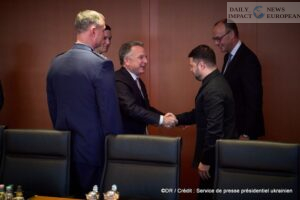
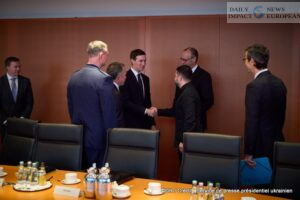
The significance of these discussions was amplified by the exceptional presence of Western leaders in Berlin to finalize the contours of this strategic agreement.
Among those present were:
- Alexander Stubb, President of Finland;
- Donald Tusk, Prime Minister of Poland;
- Emmanuel Macron, President of France;
- Friedrich Merz, German Federal Chancellor;
- Volodymyr Zelensky, President of Ukraine;
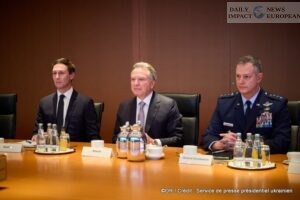
- Steve Witkoff, US Special Envoy;
- Jared Kushner, US Presidential Adviser;
- Giorgia Meloni, Prime Minister of Italy;
- Jonas Gahr Støre, Prime Minister of Norway;
- Mark Rutte, NATO Secretary-General;
- Mette Frederiksen, Prime Minister of Denmark;
- Ursula von der Leyen, President of the European Commission;
- Dick Schoof, Prime Minister of the Netherlands;
- Ulf Kristersson, Prime Minister of Sweden.
This unprecedented configuration illustrates strategic alignment between the European Union, NATO, and the United States, reflecting a willingness to treat Ukraine as a central pillar of future European security.
The Key Role of the United States and Security Guarantees
A senior American official stated that the draft agreement from the Berlin negotiations would include “very strong” security guarantees, comparable to those under NATO’s Article 5.
Without detailing operational specifics, this statement suggests a sustained US political commitment, even outside a formal Ukrainian accession to the Atlantic Alliance.
Zelensky: Dialogue, Firmness, and Red Lines
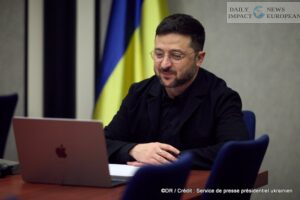
During his interventions in Berlin, Volodymyr Zelensky combined diplomatic openness with strategic firmness. He acknowledged the complexity of discussions with American and European envoys, particularly regarding territorial issues.
The Ukrainian president, however, stressed a central point: security guarantees must be understandable and credible for the Ukrainian people. Without this, no agreement could be sustainably accepted by Ukrainian society.
Germany: Political and Economic Engine
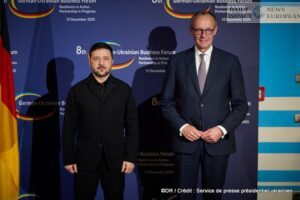
Chancellor Friedrich Merz reaffirmed that Germany stands “firmly alongside Ukraine.” Beyond military support, Berlin plays a leading role in thinking about the post-conflict economic future.
Discussions focused on strengthening bilateral cooperation in strategic sectors: energy, infrastructure, agriculture, mechanical engineering, medical technologies, and the drone industry.
Berlin will also host the first office of a new Ukrainian technological export project, symbolizing Ukraine’s orientation toward European economic integration.
Frozen Russian Assets: A Strategic Lever
Another central issue concerns the use of frozen Russian assets to finance Ukraine’s defense and reconstruction. For Kiev, this represents both a financial tool and a political message: aggression has a lasting cost.
Germany supports a European solution to use these funds legally and in a coordinated manner, while sending a clear signal to Moscow.
The Human Dimension: Civilians, Prisoners, and Memory
Alongside strategic discussions, the Ukrainian president highlighted humanitarian progress. The recent release of 114 civilians held in Belarus, including five Ukrainians, through a US-supported operation, demonstrates that diplomacy can produce concrete results even during wartime.
Peace, Deterrence, and Reconstruction: A Complex Equation
The Berlin discussions show that peace will be neither immediate nor simple. It rests on a complex equation combining military deterrence, international guarantees, economic pressure on Russia, and Ukraine’s reconstruction.
The very notion of peace is evolving: it is no longer only about silencing weapons but creating a strategic framework that prevents the resumption of conflict.
Berlin, a Laboratory for European Peace
Berlin has not ended the war in Ukraine. The discussions held there do not signal imminent victory or final resolution. They do, however, shift the conflict’s center of gravity toward a domain where diplomacy, deterrence, and the economy matter as much as military operations.
As German Chancellor Friedrich Merz emphasized, “Sustainable peace cannot exist without credible security guarantees.” Ukrainian President Volodymyr Zelensky stressed that these guarantees must be concrete, effective, and primarily understandable for the Ukrainian people—an essential condition for accepting any peace agreement.
“History will judge not the intensity of military operations nor the symbolic weight of summits, but the ability of actors to transform this diplomatic moment into verifiable, lasting, and economically viable peace for Ukraine and Europe.”
©2025 – IMPACT EUROPEAN

Views: 3
More Stories
France Protests on October 17: Mass Mobilization Overshadowed by Violence Across the Country
Work Palace Opens in Paris: INSITU Brings Luxury Hospitality Into the Workplace
Rugby Pro D2: Colomiers Defeat Narbonne 49-28 to Claim Bonus-Point Victory