


The 107th Congress of Mayors of France, held at the Porte de Versailles, was far more than a routine annual gathering. It became a political arena, staging a symbolic confrontation between the republican base – local elected officials – and the central government, embodied by Prime Minister Stéphane Lecornu.
Over the three days of discussions, a deep crisis of trust emerged, revealing a major disconnect between the expectations of local authorities and the national budgetary constraints. While the government attempted to ease tensions with words and regulatory measures, the real financial response has been postponed until 2027 — a timeline overshadowed by suspicions of political calculation.
I. A Multidimensional Crisis: Why the Republican Base Is Exhausted
The frustration expressed by the mayors is no longer a matter of simple complaints. It reflects a systemic crisis affecting local finances, security, and the capacity to act. This tension is not new, but it has now reached a breaking point.
1. Economic Asphyxiation: Inflation, DGF, and Impossible Choices
At the heart of the concerns are municipal finances. Mayors are facing a difficult equation: maintaining high-quality public services despite constrained revenues and exploding expenses.
Inflation, worsened by the energy crisis, has severely impacted local budgets. Street lighting, heating of schools and sports halls, school and urban transport — every sector has seen its costs soar.
The Dotation Globale de Fonctionnement (DGF), the main state financial allocation to local authorities, lies at the core of the dispute. Although the government promises stability or slight increases, the real purchasing power of this grant has been declining for years.
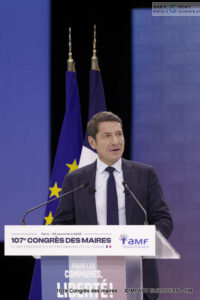
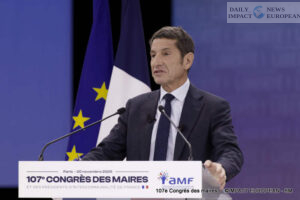
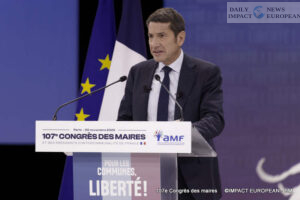
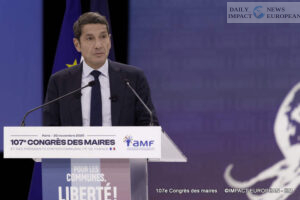
David Lisnard, President of the AMF, spoke of “gravity” to describe the growing inability to invest: school renovations, subsidies to associations, maintenance of infrastructure — each decision now becomes a painful trade-off.
Local elected officials are forced to choose between competing needs, without sufficient state support.
2. Crisis of Authority and Vulnerability of Elected Officials
Beyond financial issues, mayors are experiencing a deterioration of their authority. Verbal — and at times physical — aggressions are increasing, illustrating the weakening of republican authority at the local level.
As the last link in the State’s chain, mayors sign permits, enforce unpopular decisions, and confront social distress daily. The AMF is therefore demanding greater protection and genuine recognition of the role, so that exercising their mandate does not endanger their safety or that of their families.
A palpable sense of abandonment prevails: mayors face administrative and security challenges with insufficient backing from the central government.
3. Normative Harassment and Intrusive Technocracy
The ever-growing complexity of regulations is another major source of frustration. Urban planning, environmental procedures, public procurement: rules pile up, slowing every local project.
As one mayor noted, it is paradoxically longer, costlier, and more complicated to build local infrastructure in 2025 than it was in 2000.
This excessive bureaucracy is perceived as a sign of permanent distrust from the State toward local capacities to decide and act quickly.
The lack of simplification directly hinders local efficiency and worsens frustration.
II. A Tense Confrontation: AMF vs. Government
The final day of the Congress crystallized the tension. The stage became the site of a symbolic duel between the territorial base and the executive.
1. David Lisnard: Testimony and Ultimatum
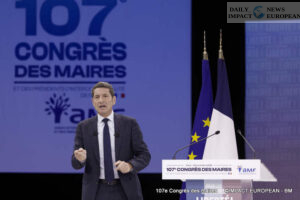
The speech by David Lisnard, President of the AMF and Mayor of Cannes, was a key moment. He succeeded in turning an annual gathering into a powerful instrument of political pressure.
Speaking of “gravity,” Lisnard denounced symbolic tributes and demanded concrete measures:
-
Genuine decentralization: real transfer of powers and greater autonomy for municipalities
-
Durable financial guarantees: securing local public services independently of national budget fluctuations
-
Administrative simplification: eliminating unnecessary regulatory constraints
His now iconic “Enough words, we want action” provoked a standing ovation, demonstrating rare unity among local elected officials and placing the government under intense pressure.
2. Stéphane Lecornu: Empathy and Caution
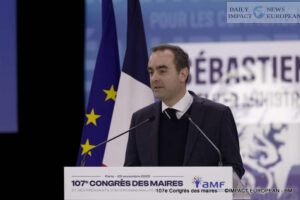
Facing this discontent, Prime Minister Stéphane Lecornu adopted a two-step strategy:
Political empathy – He acknowledged the legitimacy of the concerns and praised the crucial role of mayors. He announced concrete measures to protect elected officials and strengthen criminal sanctions — subjects where consensus is easy.
Regulatory response – Unable to release massive funds due to national budget constraints, he instead opted for targeted administrative simplification:
-
Public procurement: higher thresholds for simplified procedures
(works up to €100,000, supplies up to €60,000) -
Tertiary Decree: energy obligations extended to 2030 instead of 2027, aligning timelines with the 2026–2032 municipal term
-
Removal of absurd constraints: such as ending mandatory annual draining of municipal swimming pools
But on the core financial issue — DGF and unconditional support — the Prime Minister remained firm:
no blank check, only targeted and conditional aid (Green Fund, territorial engineering).
III. The Electoral Trap: 2027 in Sight
The timeline of the announcements was immediately interpreted as politically motivated.
-
Mayors must vote their 2026 budgets in a context of uncertainty.
-
Major financial reforms and substantial support will only take effect in 2027.
-
This postponement coincides with the start of the post–March 2026 municipal term, leaving mayors to manage their first year without concrete backing.
Observers see this as a strategy allowing the State to secure its national finances and limit electoral risk — while giving the illusion of a gradual show of support.
But this approach carries a major risk:
the erosion of trust between the State and local representatives, potentially weakening the republican bond and fueling feelings of abandonment.
IV. Conclusion: Between Symbolic Gestures and Financial Reality
The 107th Mayors’ Congress revealed a deep territorial divide.
Local elected officials expressed their anger and sense of gravity with unprecedented clarity. The government responded with targeted, symbolic simplifications — but no immediate financial solution.
The real outcome will unfold first during the adoption of 2026 budgets, then in 2027, when promised assistance is finally deployed.
The timeline suggests political calculation but also highlights the urgent need to rebuild a true partnership between the State and its local representatives.
Central question remains:
Will these delayed measures be enough to restore mayors’ trust and preserve local public services,
or will this extended waiting period deepen disillusionment within French municipalities?
And ultimately:
“Is this tight schedule really a coincidence?
Or does the timing of concrete aid coincide with preparing public opinion for the 2027 presidential election — allowing the government to present itself as the great reformer who finally supported the territories?”
©2025 – IMPACT EUROPEAN






















Views: 0
More Stories
Alzheimer Research Foundation Gala in Paris: when music and solidarity unite for global research
Foire du Trône: inside Europe’s largest fairground in Paris
Pro-Palestinian demonstrations held across France to mark Land Day