

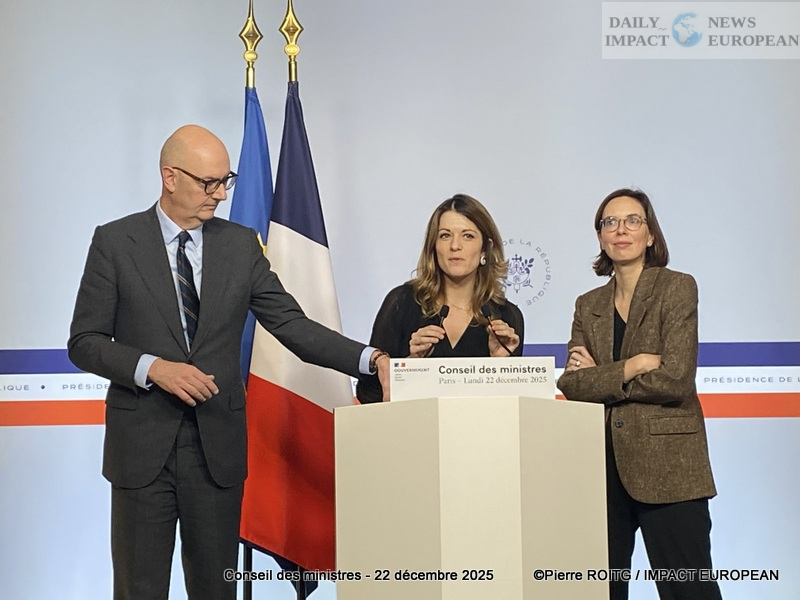
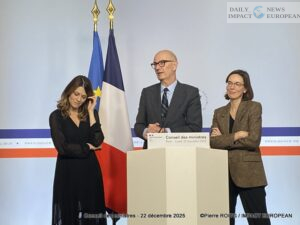
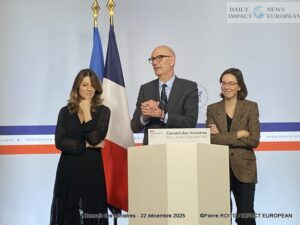
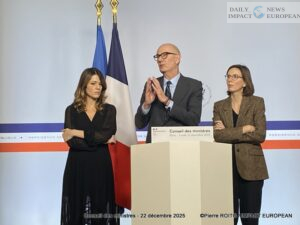
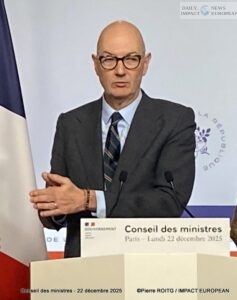
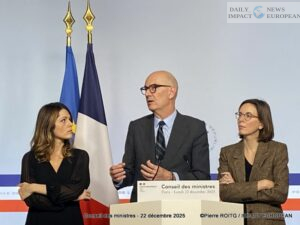
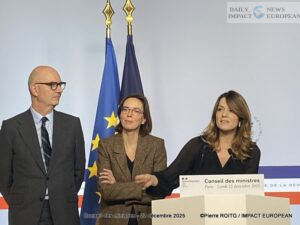
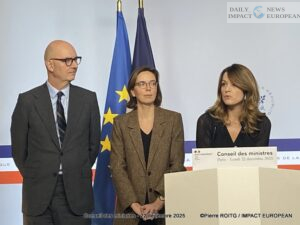
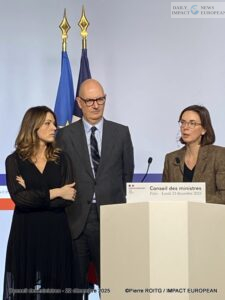
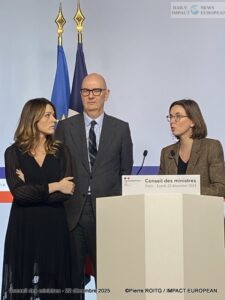
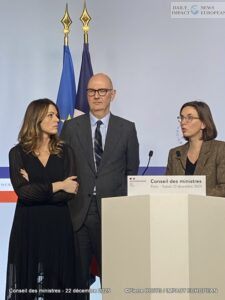
The Council of Ministers met on Monday evening, December 22, 2025, to adopt a special law aimed at ensuring the financial continuity of the state in the absence of a budget approved for 2026. This measure comes after the failure of the Joint Committee (Commission Mixte Paritaire, CMP) between deputies and senators to reach an agreement on the 2026 budget. The text is expected to be voted on by Parliament before the end of the year.
A Temporary Legislative Tool
The special law project, 16 pages long and consisting of three articles, is based on Article 45 of the Organic Law of August 1, 2001, relating to finance laws (LOLF). It temporarily authorizes the collection of state revenues and the financing of essential public expenditures, without modifying the current budget, starting January 1, 2026. According to government spokesperson Maud Bregeon, the text does not have a marked political character. It is scheduled to be examined and voted on Tuesday, December 23.
Statements from Key Figures
President Emmanuel Macron emphasized the provisional nature of the measure, according to the spokesperson:
« We must, as soon as possible in January, provide the nation with a budget. »
He also reaffirmed the 5% deficit target.
Prime Minister Sébastien Lecornu specified that the budget remains “voteable without government intervention” (without using Article 49.3).
Economy Minister Roland Lescure described the law as a “minimum service that allows us to gain time.”
Historical Context: An Exceptional Procedure
-
2024-2025: Immediate precedent following the censure of the Barnier government. Law n° 2024-1188 ensured the continuity of the state.
-
1979: After the Constitutional Council fully annulled the budget, a special law was passed to authorize the collection of taxes.
-
1962: Delays caused by early elections required a similar procedure.
These measures remain exceptional and temporary, ensuring only the continuity of essential public services without modifying the ongoing budget.
The use of this special law highlights the difficulties in achieving a stable majority in Parliament. While it guarantees the operation of public services, it places the executive under pressure for the discussions scheduled in January 2026. The key challenge will be to turn this temporary measure into a lasting political agreement. The special law is expected to be voted on by Parliament on December 23, 2025, to ensure the state’s financial continuity at the start of the year. Discussions on the 2026 finance bill will resume early next year.
©2025 – IMPACT EUROPEAN






Views: 0
More Stories
Alzheimer Research Foundation Gala in Paris: when music and solidarity unite for global research
Foire du Trône: inside Europe’s largest fairground in Paris
Pro-Palestinian demonstrations held across France to mark Land Day