

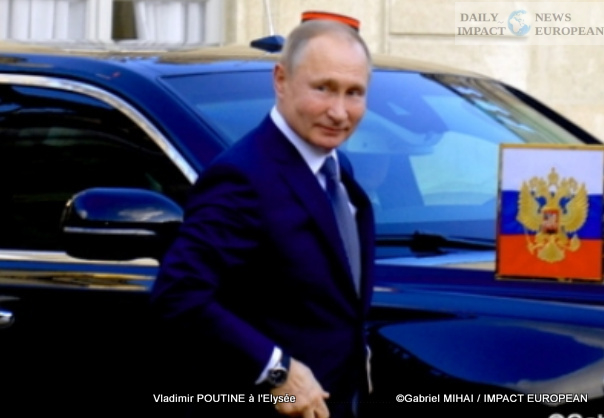
The statements made by Vladimir Putin regarding NATO during the annual “Year in Review” programme were delivered within a highly controlled political setting. Far from being improvised, this appearance serves as a strategic platform through which the Russian president shapes narratives for both domestic and international audiences.
Beyond the explicit accusations of “irresponsibility” levelled at NATO and its Secretary General, the structure of Putin’s remarks reveals a carefully constructed narrative that sheds light on current power dynamics between Russia, Europe and the United States.
A Deliberate Focus on the United States
Throughout his intervention, Vladimir Putin consistently targeted the United States, describing it as:
-
NATO’s founder,
-
its principal financial contributor,
-
and the main provider of military capabilities.
This rhetorical framing is not incidental. It allows NATO to be portrayed as an extension of American power, while other member states are pushed into the background or rendered politically invisible.
In reality, NATO operates on a fundamental principle: decisions are taken by consensus among 32 sovereign member states, the majority of which are European. By omitting this institutional reality, the Russian narrative deliberately distorts how the Alliance functions.
Europe Absent from the Narrative, Central in Reality
One of the most striking elements of the speech is the near-total absence of European countries from Putin’s analysis. Yet it is precisely NATO members in Eastern Europe — Poland, the Baltic states, Romania and Bulgaria — that have voiced the strongest security concerns.
Romania, for example, has repeatedly reported incidents involving Russian drones near or even over its territory, leading to permanent reinforcement of aerial surveillance. This security reality is also illustrated by the strengthening of the strategic partnership between France and Romania, recently highlighted in Paris within the framework of NATO cooperation. These well-documented facts are absent from the Russian president’s discourse.
Recent statements from Putin: linking security to respect for Russian interests
During the same programme, Vladimir Putin also told BBC News, according to X⚡️INFOLIVE:
“There will be no [military special] operation if you treat us with respect, if you respect our interests, just as we have always tried to respect yours. If you do not deceive us, as you have done with NATO’s eastward expansion. Western politicians created the current situation with their own hands and continue to exacerbate it. This is done to create an image of the enemy, namely Russia. To cover errors that have been systematically committed by many Western governments over the past years, both in economic and social policy.”
This statement reflects a discursive logic in which Russia presents the absence of military action as conditional on the respect it believes it is owed for its strategic interests, as also illustrated by the recent peace negotiations in Berlin on Ukraine.
It does not constitute an operational announcement but illustrates a communication posture aimed at shifting responsibility for tensions onto Western decisions, while downplaying the political and security role of European countries.
A Strategy of Political Dissociation
By concentrating responsibility on Washington, Vladimir Putin advances a communication strategy aimed at:
-
reframing the conflict as a bilateral confrontation between Russia and the United States,
-
minimising the security concerns of European states,
-
and undermining the strategic autonomy of NATO’s European members.
This approach enables Moscow to challenge the legitimacy of European defence choices by portraying them as the result of American influence rather than sovereign decisions taken in response to perceived threats.
A Deliberate Strategic Ambiguity
Nothing in the “Year in Review” speech amounts to a formal declaration of intent to wage war against Europe. However, the gap between rhetoric and observable security realities raises legitimate questions.
Military pressure along NATO’s eastern flank, repeated incidents near European borders, and the persistent denial of Europe’s political role in official Russian discourse suggest a strategy in which Europe is involved without being explicitly acknowledged.
This ambiguity allows Moscow to maintain political deniability while preserving its capacity for military and psychological pressure on the European continent.
Strategic Reading Rather Than Stated Intent
This analysis does not claim that Vladimir Putin openly announces a war against Europe. What it does reveal, however, is a discursive preparation: Europe is portrayed as a secondary, dependent actor — almost absent politically — despite being directly exposed to the consequences of the conflict.
This disconnect between official discourse and realities on the ground represents a core element of Russia’s strategic posture and a key factor in the persistent tensions between Moscow and European NATO members.
Vladimir Putin’s remarks during the “Year in Review” should not be read merely as criticism of NATO, but as a strategic attempt to redefine responsibility and lines of confrontation. By targeting the United States while erasing Europe from the narrative, the Russian president sustains an ambiguity that continues to fuel tensions across the continent.
For European NATO members, this ambiguity itself has become a significant factor of strategic insecurity.
©2025 – IMPACT EUROPEAN
Views: 0
More Stories
Phenom 300E: The World’s Leading Light Jet for 14 Consecutive Years
Art Capital, 20 Years Already
Chers Parents Premieres in Paris