

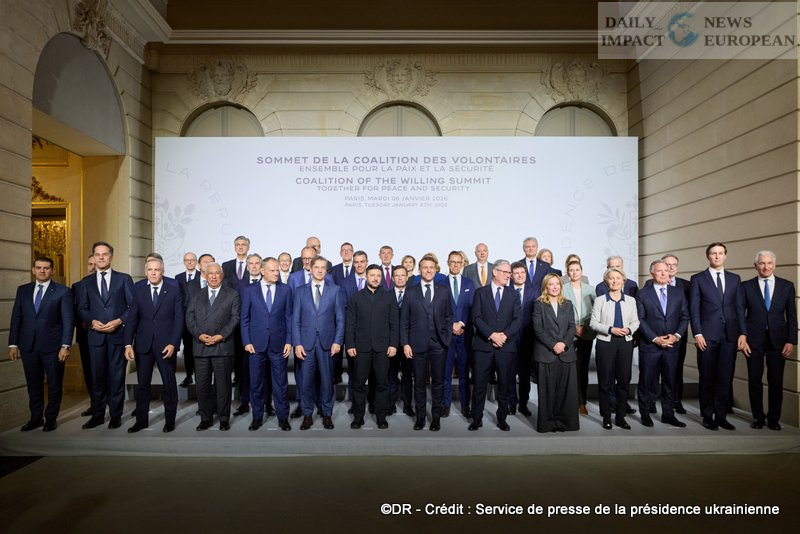
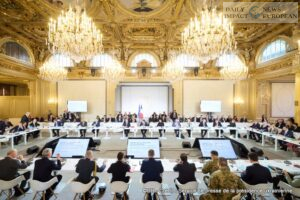
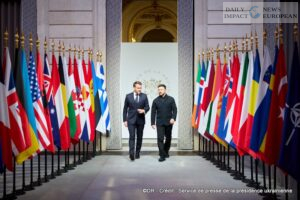
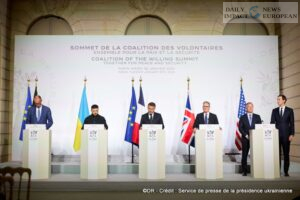
Meeting in Paris within the framework of the Coalition of the Willing, Ukraine, the United States, and a broad group of European and international partners have taken a decisive step toward shaping a post-war security architecture designed to ensure a strong, sustainable, and enforceable peace in Ukraine. The Paris meeting comes at a pivotal diplomatic moment, shortly after President Volodymyr Zelensky’s December 29 meeting in the United States with Donald Trump, aimed at resolving the remaining “10 percent” of unresolved issues in the draft peace framework.
A Broad and Global Coalition
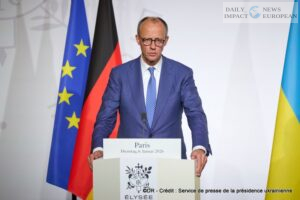
The Paris gathering stood out for both its scale and its political significance. According to President Zelensky, 27 heads of state and government participated, alongside representatives of the European Union, NATO, and partners from Türkiye, Japan, Australia, and New Zealand. This broad international presence underscored a shared determination not to allow European security to rest on fragile or purely declaratory commitments, but instead to anchor peace in credible, operational, and legally binding mechanisms.
The central objective is clear: any future peace agreement must go beyond a temporary halt in fighting and establish a durable settlement capable of deterring renewed Russian aggression.
Signed Documents to Anchor Commitments in Law
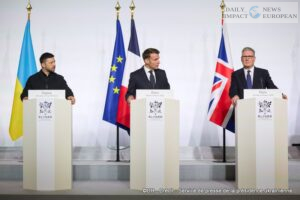
At the conclusion of the Paris meeting, key political documents were formally signed: a joint declaration by all members of the Coalition of the Willing, as well as a trilateral declaration between France, the United Kingdom, and Ukraine. President Zelensky emphasized that these documents are not symbolic statements but concrete instruments intended to translate political will into enforceable commitments.
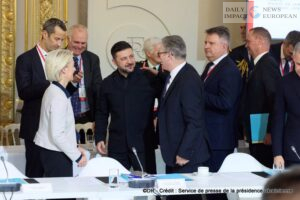
“Thanks to these documents, we are continuing legal work in the relevant countries, including with national parliaments, so that when diplomacy succeeds in ending the war, we will be fully ready to deploy the forces of the Coalition of the Willing,” Zelensky stated. He added that additional documents define operational modalities, including command structures, force composition, and coordination mechanisms.
Ukraine as the Cornerstone of European Security
The Paris Declaration makes explicit that Ukraine’s ability to defend itself remains the cornerstone of its future security and of broader Euro-Atlantic stability. Ukraine’s armed forces are to remain the first line of defense and deterrence, supported by long-term military assistance from the Coalition.
This support includes:
-
sustained military aid and essential equipment,
-
financial assistance for defense procurement,
-
continued cooperation on Ukraine’s state defense budget,
-
access to defense stockpiles for rapid reinforcement in case of renewed attack,
-
practical and technical support for defensive fortifications.
Zelensky stressed that all other security mechanisms depend on the strength, sustainability, and proper financing of Ukraine’s armed forces.
Legally Binding Security Guarantees
One of the most significant outcomes of the Paris meeting is the agreement in principle to establish politically and legally binding security guarantees, to be activated once a credible ceasefire enters into force. These guarantees are designed to prevent a repetition of past failures, such as the Minsk agreements, which lacked enforcement mechanisms.
Key components include:
-
participation in a U.S.-led ceasefire monitoring and verification mechanism, supported by Coalition members;
-
the establishment of a special commission to assess violations, assign responsibility, and determine corrective measures;
-
binding commitments to support Ukraine in the event of a renewed Russian armed attack, potentially involving military capabilities, intelligence and logistical support, diplomatic initiatives, and additional sanctions.
For Kyiv, parliamentary approval—particularly by the U.S. Congress—is essential to ensure the durability and credibility of these guarantees beyond short-term political cycles.
A Multinational Force to Prevent Renewed Conflict
The Declaration also provides for the creation of a Multinational Force for Ukraine, composed of voluntary contributions from Coalition states. Its mission is to support the reconstitution of Ukraine’s armed forces and strengthen deterrence across air, land, and maritime domains.
Military planning is already advanced. Participating countries have defined force levels, command arrangements, and operational roles. These reassurance measures will be implemented at Ukraine’s request once a credible cessation of hostilities is established. Europe will lead the force, with participation from non-European Coalition members and support from the United States.
The United States as a Central Strategic Actor
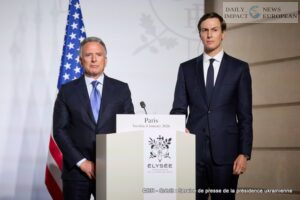
The presence of senior U.S. representatives in Paris confirmed Washington’s central role in the future security framework. Discussions with the American delegation focused on ceasefire monitoring, enforcement mechanisms, and the finalization of bilateral and trilateral security guarantee documents.
Zelensky welcomed U.S. readiness to engage, noting that deterrence is one of the most critical elements for preventing renewed aggression. Progress has been made on draft U.S.–Ukraine security agreements, with signatures potentially forthcoming.
Air Defense and Sustained Pressure on Russia
Despite diplomatic progress, the security situation remains volatile. Russia continues to strike Ukraine’s energy infrastructure and civilian areas, making air defense a constant priority. Kyiv reiterated its need for a steady supply of air defense systems and interceptors.
Coalition partners reaffirmed that, as long as Russia fails to demonstrate genuine commitment to peace, pressure must be maintained through a combination of military support, sanctions, and coordinated diplomacy, including measures targeting Russia’s energy sector and shadow fleet.
Toward a Post-War Security Architecture
Beyond immediate negotiations, the Paris meeting marked the emergence of a structured and operational post-war security architecture. Zelensky emphasized that Ukraine has never been an obstacle to peace; responsibility now lies with Russia to cease aggression.
The Paris Declaration sends a clear strategic message: peace in Ukraine will not be fragile or provisional. It will be built on formalized commitments, credible deterrence, and clearly defined responsibilities. The challenge ahead lies in converting political agreements into fully binding instruments—closing the remaining gaps in the peace framework and ensuring that any future settlement is both enforceable and enduring.
©2026 – IMPACT EUROPEAN
Views: 0
More Stories
Paris “Iftar of Peace”: Imam Hassen Chalghoumi awards Olive Branch Peace Prize to President Donald Trump
Super League: Wigan Warriors defeat Toulouse Olympique 36-16
Lunar New Year 2026: Paris Celebrates the Year of the Fire Horse