

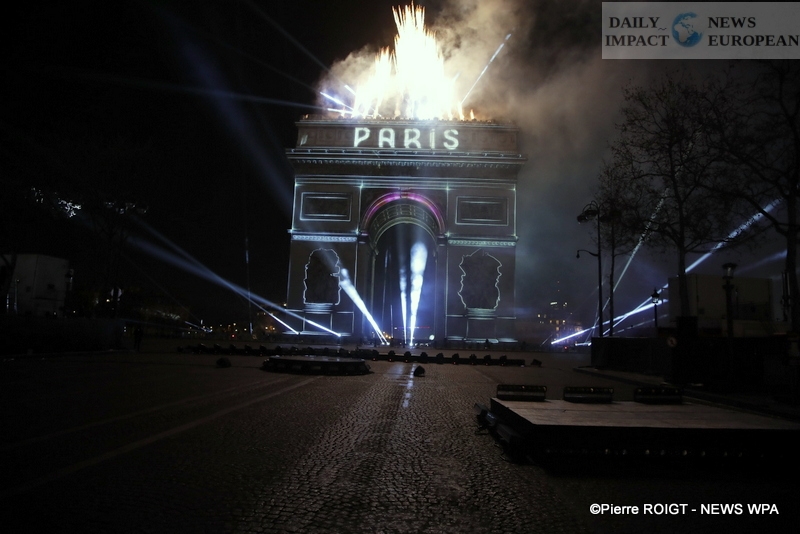
As the world welcomed 2026, major cities across continents experienced markedly different New Year’s Eve celebrations. While several global capitals reported incidents ranging from urban unrest to public safety challenges, Paris recorded a highly unusual outcome: no vehicle or urban furniture fires were reported during the night, according to the Paris public prosecutor’s office.
This development places the French capital in contrast with the broader international picture, as cities across Europe, Asia, the Americas, the Middle East and Africa faced varying degrees of disruption during the transition from 2025 to 2026.
A Controlled Night in Paris
In Paris, 125 individuals were taken into police custody, mainly for violence-related offenses, participation in violent groups or possession of prohibited substances. Authorities nevertheless emphasized that no cars or public infrastructure were set on fire, a first for New Year’s Eve in the capital in many years.
A large-scale security deployment was implemented, with thousands of police officers mobilized across the city. Unlike previous years, no major public concert was organized, with celebrations limited to a midnight fireworks display.
Contrasting Situations Across Global Capitals
Across the globe, New Year’s Eve unfolded under very different circumstances.
In Sydney, celebrations centered on large-scale fireworks and waterfront gatherings, requiring extensive crowd control operations.
In Beijing, festivities remained tightly regulated, with public events closely supervised by authorities.
In Dubai, large crowds gathered around landmark fireworks displays, with security forces focusing on crowd management and traffic control.
In Moscow, Seoul and Sofia, New Year’s Eve passed amid heightened security measures, reflecting broader geopolitical and domestic concerns.
In Budapest and London, police reported interventions linked to alcohol-related incidents, fireworks misuse and localized disturbances.
The Americas: Public Safety Challenges
In Canada and the United States, New Year’s Eve saw a mix of festive gatherings and law enforcement interventions, particularly in major metropolitan areas.
Across Brazil and Argentina, large street celebrations were accompanied by incidents related to overcrowding, alcohol consumption and sporadic urban disorder.
In the Caribbean, including Cuba, authorities maintained strict controls over public events, balancing celebrations with public safety considerations.
Africa and the Mediterranean Basin
In North Africa, including Morocco and Algeria, New Year’s Eve was marked by heightened police presence in major cities, reflecting ongoing efforts to prevent unrest during public celebrations.
In South Africa, law enforcement agencies reported incidents linked to fireworks and public disorder in several urban areas.
A Global Contrast
Against this international backdrop, Paris’s absence of vehicle fires stands out as an exception rather than the norm. While the French capital did record a significant number of arrests, the lack of large-scale material damage suggests a shift in how urban security was managed during the festivities.
Whether this outcome reflects a sustainable change or a temporary result of exceptional security measures remains an open question. However, as cities worldwide continue to grapple with the challenges of managing mass celebrations, the Paris New Year’s Eve of 2026 is likely to be observed as a notable case study in urban security and crowd control.
©2025 – IMPACT EUROPEAN
Views: 0
More Stories
Alzheimer Research Foundation Gala in Paris: when music and solidarity unite for global research
Foire du Trône: inside Europe’s largest fairground in Paris
Pro-Palestinian demonstrations held across France to mark Land Day