


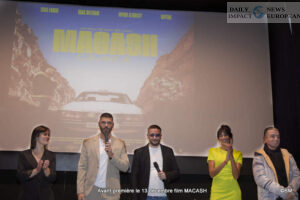
Presented at its Parisian premiere on December 13 at the Christine Cinéma Club, MACASH is the first feature film by Max Beltran, who wrote, directed and also plays one of the leading roles. The film had previously screened to a sold-out audience in Lyon on November 2, marking the beginning of a festival run ahead of a screening scheduled at the Palace Brussels on February 25, 2026, following several festivals including Cinemamed.
Shot in Morocco, in the villages of Aourir and Tifnit near Agadir, MACASH positions itself as a psychedelic dramatic thriller, carried by an atypical Franco-Moroccan production and a claimed budget of around €10,000.
Between waking dream and brutal nightmare
The film follows Yoni and Max, two thirty-somethings from a privileged background, sent to inspect an abandoned family ranch. This seemingly harmless premise quickly turns into a succession of violent and disorienting events, where parties, hallucinations and deaths collide without warning. The boundary between dream and reality is deliberately blurred, at the risk of unsettling the viewer.
This fragmented narrative is both the film’s strength and its limitation: it mirrors the mental state of its characters, while sometimes disorienting audiences through the absence of conventional narrative markers.
Tifnit: a village that no longer exists
The filming in the village of Tifnit takes on a historical and tragic dimension. December 2023 will remain etched as a dark — very dark — moment in the history of this fishing village, located about forty kilometres south of Agadir, within the Souss-Massa National Park. On December 6, 2023, the Director of Infrastructure of the province of Chtouka Aït Baha, Mohamed Zouhair, issued an order demanding the restoration of illegally built homes to their original state within five days.
Around 200 residents — mainly fishermen, some from families that had lived there for generations — saw their homes destroyed. On December 28, the rubble was covered with earth, and Tifnit disappeared completely. Nothing remains of what was described as the only village of its kind still existing in Morocco. The destruction was part of a major tourism development project known as “Blue Safari,” which plans an 80-kilometre route through the park, featuring new leisure and accommodation facilities. The total cost of the project is estimated at 1.5 billion dirhams (€138 million), including 200 million dirhams funded by the Moroccan state.
This disappearance gives the film an almost documentary dimension: MACASH captures places that no longer exist, frozen in time and now invisible.
A collective and independent work
MACASH is the result of a collective Franco-Moroccan effort developed over nearly two years of production. Max Beltran describes it above all as a human adventure:
“Shooting in Aourir, a village never before seen in cinema, was a crazy adventure. Thanks to the entire France–Morocco team for these two intense years,” says the director.
An imperfect but singular film
With its limited resources, MACASH does not seek technical perfection. Instead, it offers a sensory and narrative experience rooted in a radical tradition of independent cinema, likely to divide as much as it attracts. More than a genre exercise, the film reflects a desire to create outside dominant circuits, drawing on the energy of a multinational team and on locations rarely — if ever — shown on screen.
Cast and full crew
The film brings together a multinational Franco-Moroccan cast and crew, including:
Ophir Azoulay, Leïla Fared, Philippe Moyssan, Roxane Klg, Olivier Martel, Didier Laval, Paul Joaquim Pereira, Bouchra Bouc, Alexandre De Lilla, Laurent Graziano, Yanis Kiiriiquou, Najib Guerfi, Salah Messoussa, Rachid Leghrib, Nordine Mess, Yasmine Ouchène.
An enthusiastic team that took great pleasure in making this film.
©2025 – IMPACT EUROPEAN




Views: 0
More Stories
Alzheimer Research Foundation Gala in Paris: when music and solidarity unite for global research
Foire du Trône: inside Europe’s largest fairground in Paris
Pro-Palestinian demonstrations held across France to mark Land Day