

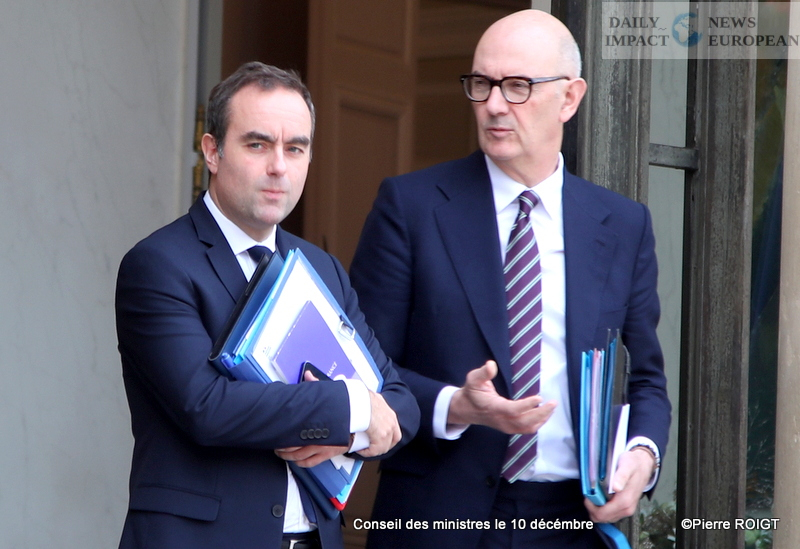
The President of the Republic chaired the Council of Ministers at the Élysée Palace this Wednesday, December 10. The decrees adopted and the individual measures announced confirm a dual governmental dynamic: adapting French law to the European framework and strengthening staff in sovereign functions and the healthcare sector.
Major Decrees: Modernisation and European Alignment
Two decrees requiring consultation with the Council of State were presented and adopted, covering consumer law and access to healthcare.
The New Approval Procedure for Class Actions
The Minister for Small and Medium Enterprises, Trade, Crafts, Tourism and Purchasing Power presented a decree finalising the overhaul of the class action regime.
Reform Context:
This decree implements Article 16 of Law No. 2025-391 of 30 April 2025 (known as the DDADUE Law), which transposes European Directive (EU) 2020/1828. This legislation aims to harmonise French law with EU standards, particularly regarding the protection of collective consumer interests.
Objectives and Key Provisions:
This new unified regime breaks with the former sector-based approach (health, environment, consumer affairs) and covers both the cessation of unlawful practices and compensation for damages.
-
Expanded Standing to Sue: While public prosecutors may now file cessation actions, compensation claims remain limited to non-profit associations specifically approved by the administrative authority.
-
Single Approval Authority: The Directorate-General for Competition, Consumer Affairs and Fraud Control (DGCCRF) is designated as the sole competent authority to issue such approvals, greatly simplifying procedures.
-
Financial Transparency: The decree requires the publication of funding sources, including third-party financing, to ensure independence and prevent conflicts of interest.
Implementation: The new class action regime will take effect on 1 January 2026.
Recognition of Medical Dispatch Assistants Trained in the EU
A second decree facilitates the arrival in France of medical dispatch assistants trained in other European countries.
Objectives:
-
Reinforce emergency response teams.
-
Accelerate the recognition of foreign qualifications.
Reform Context:
The text is based on Law No. 2023-379 of 19 May 2023 (known as the Rist Law) aimed at improving access to healthcare. This law sought to enhance the mobility of healthcare professionals to combat medical shortages. The decree applies this ambition specifically to Medical Regulation Assistants (MRAs), who play a crucial role in triaging and managing emergency calls.
Objectives and Procedure:
The decree details the recognition process for MRA training qualifications issued by an EU Member State, the EEA or Switzerland.
-
National Authority: A regional prefect will be designated, by ministerial order, as the sole authority to assess all applications nationwide.
-
Scope: The procedure applies to both permanent establishment and temporary service provision, while ensuring patient safety and quality of care.
This measure aligns with Directive 2005/36/EC, promoting mobility of healthcare professionals within the EU while maintaining high standards.
©2025 – IMPACT EUROPEAN


























Views: 0
More Stories
Alzheimer Research Foundation Gala in Paris: when music and solidarity unite for global research
Foire du Trône: inside Europe’s largest fairground in Paris
Pro-Palestinian demonstrations held across France to mark Land Day