

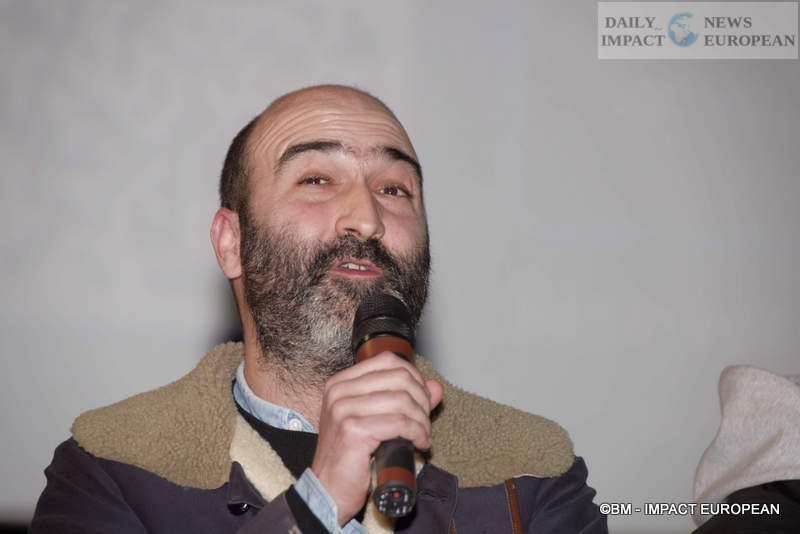
The film Grand Ciel held its Paris premiere on January 8 at UGC Les Halles, ahead of its nationwide theatrical release on January 21, 2026.
Directed by Japanese filmmaker Akihiro Hata, Grand Ciel marks his first feature film. A graduate of La Fémis (Directing, class of 2010), Hata steps into feature-length cinema with an ambitious social drama infused with thriller and fantastical elements, led by acclaimed French actor Damien Bonnard, alongside Samir Guesmi.
A Futuristic Construction Site with Dark Secrets
Synopsis
Vincent works the night shift on the construction site of Grand Ciel, a vast eco-futuristic urban district presented as a masterpiece of modern engineering. When one worker mysteriously disappears, Vincent and his colleagues begin to suspect that management has covered up a serious accident. Soon after, another worker goes missing, and the atmosphere on the site grows increasingly tense and unsettling.
Set almost entirely within the cold, mineral world of a gigantic construction site, Grand Ciel plunges Vincent and Saïd—night workers enduring harsh labor conditions—into a disturbing environment filled with unexplained noises echoing through the structure’s depths and an omnipresent, excessive dust that hangs in the air like a toxic fog. What begins as a social realist portrait gradually morphs into something darker and more ambiguous.
Between Social Drama and Genre Cinema
Selected in the Orizzonti section at the Venice Film Festival, Grand Ciel establishes Akihiro Hata as a filmmaker with a clear visual identity and a strong social conscience. The film’s most striking achievement lies in its ability to translate abstract ideas—alienation, exploitation, and invisible labor—into a tangible cinematic object.
Concrete dominates the screen: cold, omnipresent, suffocating. Dust infiltrates every crack, threatening to engulf both the workers and the viewer, while the endless construction continues at any cost. This oppressive physicality is one of the film’s great strengths. The environments, meticulously crafted with the help of cinematographer David Chizallet and production designers Aurore Casalis and Mathieu Buffler, feel almost tactile. The viewer can nearly touch the surfaces, smell the dust, and feel the weight of the structures. The palette of blues and greys, punctuated by the harsh yellows and whites of artificial construction lighting, leaves a lasting visual impression.
In this sense, Grand Ciel comes close to being a reference point for how such cinematic worlds can be imagined and built. Although 3D cinema once divided audiences, Hata achieves a similar immersive effect through texture, space, and sound design rather than spectacle.
Strong Intentions, Slight Emotional Distance
While the film is technically accomplished across the board—from performances to production design and sound—there are moments when precision seems to outweigh emotional depth. The film often engages the intellect more than the heart, creating a subtle distance between the audience and the characters. A stronger emotional resonance might have elevated Grand Ciel from a very solid debut to a truly unforgettable one.
That said, the performances are consistently compelling. Damien Bonnard delivers a restrained, credible portrayal of a man caught between loyalty, doubt, and quiet revolt, supported by a well-cast ensemble. The screenplay, co-written by Akihiro Hata and Jérémie Dubois, features realistic dialogue that grounds the film’s more abstract ambitions.
A Political Parable Beneath the Surface
Beneath its genre trappings, Grand Ciel is an engaged social parable. It addresses the exploitation of manual labor and the human cost hidden behind futuristic architecture and luxurious living spaces. The film inevitably recalls real-world scandals involving workers who lost their lives building ultra-modern infrastructures—such as the stadiums constructed for the Qatar World Cup.
Hata reminds us that behind the comfort of the privileged lie men who have sacrificed their bodies and health, working day and night in brutal conditions, breathing toxic dust, often for meager wages and little human consideration. Rather than stopping at a purely didactic statement, the filmmaker embeds this critique within a tense, slow-burning narrative that keeps the viewer trapped in a constantly uneasy atmosphere.
The film skillfully balances its clear-eyed social portrait—touching on class struggle and power dynamics—with the mechanics of a genre thriller. At times, however, Hata appears hesitant to fully embrace the fantastical dimension he introduces, choosing instead to flirt with it from a distance. A bolder plunge into ambiguity and genre might have given the film greater cinematic scope.
A Promising First Feature
For a debut feature, Grand Ciel is a remarkably controlled and thoughtful work. If it occasionally lacks “heart” and ambition, it more than compensates with its intentions, visual strength, and social relevance. Akihiro Hata proves himself a filmmaker to watch—one capable of weaving political commentary into immersive cinematic worlds.
Grand Ciel
Directed by Akihiro Hata
Runtime: 91 minutes
In French cinemas from January 21, 2026
©2026 – IMPACT EUROPEAN







Views: 0
More Stories
Paris “Iftar of Peace”: Imam Hassen Chalghoumi awards Olive Branch Peace Prize to President Donald Trump
Global Nuclear Energy Summit in Paris highlights role of nuclear power in energy transition
Super League: Wigan Warriors defeat Toulouse Olympique 36-16