

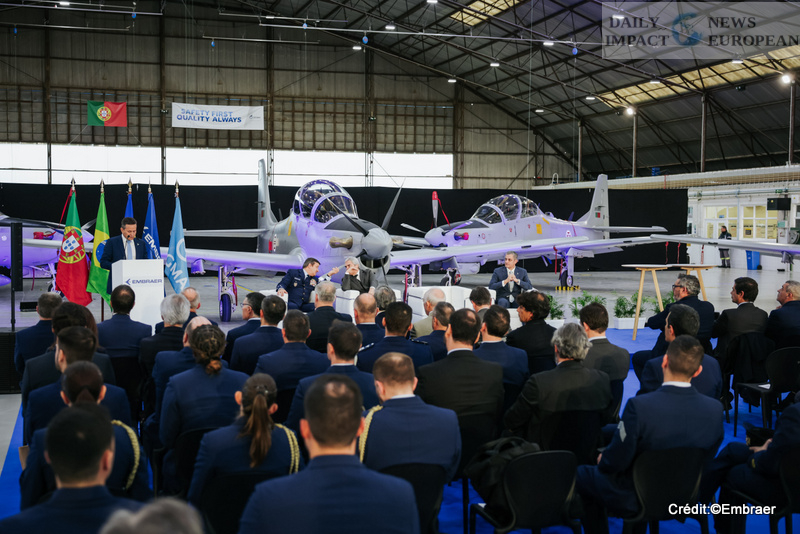
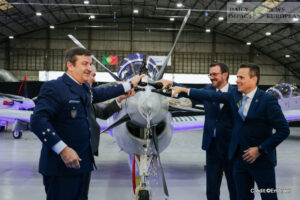
On December 17, Portugal received at Alverca the delivery of the first five A-29N Super Tucano aircraft to the Portuguese Air Force. Far from being a simple arms contract, this delivery by Embraer marks a much broader shift involving industrial sovereignty, geostrategic realignment, transformation of European military doctrines, and a redefinition of political balances between international blocs.
Through this acquisition, Portugal becomes not only the first operator of the NATO-certified version of the Super Tucano, but also a pivotal actor in the emergence of a European capability for counter-drone warfare and light air support.
A Symbolic Delivery in a Tense Strategic Context
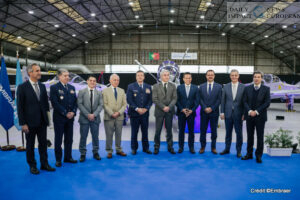
The ceremony held at the OGMA site in Alverca, attended by Portuguese civil and military authorities, Embraer executives and industrial partners, marked a historic milestone: for the first time, a light combat aircraft developed outside the Euro-Atlantic industrial perimeter has been fully certified and integrated into NATO standards.
This delivery comes amid a severely deteriorated European security environment since Russia’s invasion of Ukraine in 2022, the proliferation of asymmetric conflicts, the widespread use of armed drones, and the rise of non-state actors. European air forces now face a complex equation: maintaining credible, responsive and interoperable capabilities without bearing the exorbitant costs of high-intensity fighter aircraft.
Portugal’s decision to acquire twelve A-29N Super Tucano aircraft fits precisely within this logic of operational and budgetary rationality.
A Political Choice Between National Sovereignty and NATO Commitment
Portuguese Defense Minister Nuno Melo emphasized the political significance of the decision:
“We are not merely introducing a proven air attack capability; we are anticipating the conflicts of tomorrow. The Super Tucano enables counter-drone missions, support to deployed forces, and operations in permissive and semi-permissive environments. This is a military choice based on rigorous technical evaluation, politically validated in Portugal’s strategic interest.”
This statement reflects a notable evolution in Portuguese strategic thinking. Traditionally focused on territorial defense and naval missions, Lisbon now openly embraces an expanded role in expeditionary operations, particularly in Africa and within UN peacekeeping frameworks.
Air Force Chief of Staff General João Cartaxo Alves highlighted the doctrinal dimension:
“The A-29N replaces platforms nearly forty years old while opening an entirely new operational spectrum. Close air support, armed ISR, force protection and NATO interoperability represent a major qualitative leap.”
The A-29N: A NATO Version Designed for Europe
The A-29N differs significantly from previously exported A-29 variants. It incorporates:
-
Secure NATO-standard communications systems
-
Full interoperability with allied forces
-
Enhanced drone detection and engagement capabilities
-
Advanced avionics with a modern human-machine interface
-
An open architecture allowing future upgrades
These adaptations directly address capability gaps identified by several European military staffs confronted with the rapid proliferation of tactical drones.
Counter-Drone Warfare: A Central Challenge
Conflicts in Ukraine, the Middle East and Africa have demonstrated how low-cost drones can neutralize far more expensive systems. In this context, the A-29N represents a pragmatic response: capable of intercepting, identifying and neutralizing drones at a fraction of the operating cost of multirole fighters.
For many European defense planners, light combat aircraft are once again becoming central tools—complementary, not competing, with high-end platforms such as the Rafale, Eurofighter or F-35.
Assembly Line in Portugal: Industry and Sovereignty
The signing of a letter of intent between Embraer and the Portuguese state to establish a final assembly line in Portugal represents another major shift. Such infrastructure would:
-
Strengthen Portugal’s defense industrial and technological base
-
Position Portugal as a European hub for the A-29N
-
Respond to growing European demand
-
Create skilled jobs and enable technology transfers
Bosco da Costa Junior, CEO of Embraer Defense & Security, stated:
“European interest in counter-drone and light air support missions is real. An assembly line in Portugal would open a new chapter of strategic industrial cooperation.”
Embraer: A Global Player from the BRICS+ Sphere
Based in Brazil, Embraer is one of the few aerospace manufacturers capable of covering the full spectrum of aviation: commercial, business, defense and security. Since 1969, it has delivered over 9,000 aircraft worldwide.
Brazil is a founding member of the BRICS group, now expanded into BRICS+ with the recent integration of Egypt, Ethiopia, Iran, Saudi Arabia, the United Arab Emirates and Indonesia—representing nearly 39% of global GDP in purchasing power parity.
Cooperation between a NATO member state and a BRICS+ industrial actor illustrates a pragmatic reconfiguration of international partnerships, driven more by operational efficiency than ideological alignment.
Countries Operating the A-29 Super Tucano
To date, the A-29 Super Tucano is in service or selected by 22 air forces, including Brazil, Colombia, Chile, Ecuador, Paraguay, Uruguay, the Dominican Republic, Guatemala, Honduras, Panama, Nigeria, Ghana, Angola, Mauritania, Senegal, Burkina Faso (programs partially suspended), Afghanistan (pre-2021), the United States (training and evaluation), Portugal (first NATO operator), and several others across Africa, Latin America and Asia.
This diversity highlights the platform’s adaptability across varied operational environments.
Operational Focus on Key Users
Brazil: As the original designer and primary operator, Brazil uses the Super Tucano extensively for Amazon surveillance, airspace control and combating transnational trafficking.
Colombia: A cornerstone of counter-insurgency operations, heavily employed against FARC and other armed groups.
Nigeria: A key asset in counter-terrorism operations against Boko Haram and ISWAP.
United States: Used by the U.S. Air Force for training, evaluation and validation of Light Attack Aircraft concepts.
Philippines and Indonesia: Primarily employed for maritime surveillance, EEZ protection and counter-insurgency in complex island environments.
Technical Specifications of the A-29N Super Tucano
Designed as a robust and versatile platform, the A-29N combines sufficient combat performance with controlled operating costs:
-
Engine: Pratt & Whitney Canada PT6A-68C turboprop, 1,600 shp
-
Maximum speed: approx. 590 km/h
-
Internal armament: two FN Herstal 12.7 mm machine guns
-
Payload: up to 1,500 kg on five hardpoints
-
Protection: armored cockpit, Martin-Baker ejection seats, full self-protection suite (RWR, MAWS, chaff/flare)
These characteristics explain why the aircraft is regarded as one of the most capable in its class for permissive and semi-permissive environments.
Doctrine, Society and Public Debate
In Portugal, the acquisition has not triggered significant societal backlash, unlike heavier weapons programs. Public debate focused on operational relevance, cost control, and national industrial benefits. Political parties across the spectrum broadly supported the program as a balanced compromise between fiscal responsibility and military credibility.
A Response to Portugal’s African Commitments
Portugal’s “Military Strategic Vision 2022–2034” explicitly highlights the need for capabilities adapted to African theaters, where Portugal is engaged, notably in the Central African Republic under the MINUSCA mission.
In such environments, the A-29N offers a rare combination of endurance, precision, robustness and affordability—well suited for stabilization and force protection operations.
A Strong Signal to Europe
With the A-29N Super Tucano, Portugal sends a clear message: European defense cannot rely solely on heavy, expensive and technologically complex programs. It must also integrate light, proven and economically sustainable platforms capable of addressing contemporary threats—from drone proliferation to asymmetric conflicts and stabilization missions.
By selecting a NATO-certified, interoperable and adaptable aircraft, Lisbon demonstrates that a pragmatic defense approach is not only possible but necessary. The Super Tucano does not replace high-intensity fighters; it complements them by undertaking missions where heavy platforms would be operationally and financially disproportionate.
Beyond the military dimension, the potential establishment of an assembly line in Portugal gives this program major industrial and political significance. It positions the country as a key player in Europe’s defense industrial base while illustrating a new form of international cooperation that transcends traditional bloc divisions in favor of converging strategic interests.
By becoming the first NATO nation to operate the A-29N Super Tucano, Portugal opens an alternative path for Europe: a more agile, realistic and cost-effective defense model—better suited to the conflicts of the 21st century, where versatility, affordability and operational effectiveness have become decisive strategic criteria.
©2025 – IMPACT EUROPEAN
Views: 0
More Stories
Anti-racism protests held in Paris and nationwide
Seniors Fair in Paris focuses on health, independence and active ageing
Paris “Iftar of Peace”: Imam Hassen Chalghoumi awards Olive Branch Peace Prize to President Donald Trump