

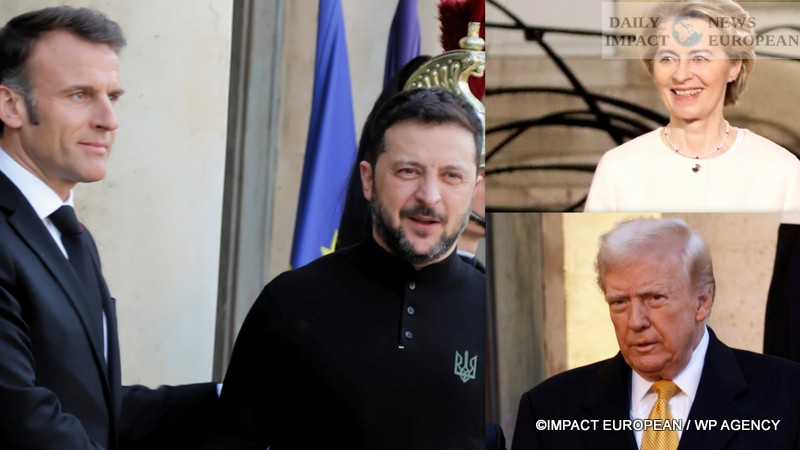
After the failed summit in Alaska between Donald Trump and Vladimir Putin, global diplomacy shifts to Washington. The U.S. president welcomes Volodymyr Zelensky, joined by key European leaders, to discuss a peace agreement, security guarantees for Ukraine, and stronger sanctions against Russia.
After more than three and a half years of war in Ukraine, diplomatic dynamics are shifting rapidly. Europeans, who fear a deal could be struck at Ukraine’s expense, intend to demonstrate unity by accompanying Volodymyr Zelensky to Washington.
Following the Alaska summit, where Donald Trump and Vladimir Putin failed to reach a ceasefire agreement, European Council President Ursula von der Leyen met today with Ukrainian President Volodymyr Zelensky.
Von der Leyen expressed her support for Ukraine, outlining three key points:
- “We need strong security guarantees to safeguard Ukraine’s and Europe’s vital security interests. Ukraine must be able to preserve its sovereignty and territorial integrity.”
- “On territorial issues in Ukraine, the position is clear: international borders cannot be changed by force. Such decisions must be made by Ukraine alone and cannot be taken without its participation.”
- “As long as the bloodshed in Ukraine continues, Europe will maintain diplomatic—and above all, economic—pressure on Russia. Europe continues to strengthen sanctions. We have already adopted 18 sanction packages, and we are preparing the 19th, expected in early September. Sanctions are effective; we have already redirected frozen Russian assets to support Ukraine. We will keep pressuring Russia’s war economy to bring President Putin to the table.”
After their meeting, von der Leyen and Zelensky joined a videoconference organized under the “Coalition of Volunteers.”
Von der Leyen also confirmed she would accompany Zelensky, alongside other European leaders—including French President Emmanuel Macron, German Chancellor Friedrich Merz, UK Prime Minister Keir Starmer, NATO Secretary-General Mark Rutte, Italian Council President Giorgia Meloni, and Finnish President Alexander Stubb—to a meeting at the White House with US President Donald Trump.
At the end of his Friday summit with Vladimir Putin, Donald Trump stated that his efforts were now focused on drafting a peace agreement to end the war, bypassing the step of a ceasefire.
On Sunday, President Zelensky called the US decision to provide Ukraine with “security guarantees” to stop the war with Russia “historic,” ahead of Monday’s meeting in Washington.
“Security guarantees, as the result of our joint work, must be truly practical, providing protection on land, in the air, and at sea, and must be developed with Europe’s participation,” Zelensky said on social media after the Coalition of Volunteers videoconference.
French President Emmanuel Macron declared Sunday that Russian President Vladimir Putin “does not want peace” but rather a “capitulation” of Ukraine, following a videoconference with Kyiv’s allies.
“There can be no territorial discussions about Ukraine without Ukrainians,” Macron said, adding, “and likewise, no discussion about European security without Europeans.” He called for Europe to be included in all upcoming Ukraine summits.
Donald Trump’s special envoy, Steve Witkoff, said Sunday that Russia had made “territorial concessions” regarding five Ukrainian regions, on the eve of Zelensky’s reception at the White House.
“The Russians made certain concessions at the table [in Alaska] concerning all five regions in eastern Ukraine. There is an important discussion about Donetsk and what will happen there,” Witkoff told CNN, two days after the Trump-Putin summit in Anchorage that brought no progress on a ceasefire.
On CBS, Secretary of State Marco Rubio stressed: “The United States is not in a position to accept or reject anything, because ultimately, it is up to the Ukrainians.” He also threatened Russia with new sanctions if no agreement is reached.
Italy’s Giorgia Meloni is expected to play a key role, acting as a bridge between the parties involved. Though ideologically close to Trump, she remains a staunch defender of Ukraine—a friendly face within the delegation, yet aligned with the European voice.
Meanwhile, a senior official revealed that Trump had supported a Russian proposal to reinforce Moscow’s presence in eastern Ukraine. According to this source, Putin “is essentially asking Ukraine to withdraw from the Donbas,” fully ceding the Donetsk and Luhansk regions. He also suggested freezing the front lines in Kherson and Zaporizhzhia in the south.
In September 2022, Russia claimed to annex these four Ukrainian regions, even though it never fully controlled any of them. Kyiv has consistently rejected all territorial concessions, citing constitutional constraints.
Trump also hinted at a possible tripartite summit with Putin and Zelensky “if things go well” when he hosts the Ukrainian president on Monday. “This meeting must take place as soon as possible,” von der Leyen insisted on Sunday.
After the Trump-Putin summit in Alaska, diplomatic schedules are accelerating. On Monday, August 18, Zelensky will travel to Washington to meet the US president, with a possible tripartite meeting to follow before August 22.
©2025 – IMPACT EUROPEAN
Views: 0
More Stories
Saudi Arabia’s new power equation: Why Paris matters to Riyadh
Mas-d’Azil Cave: A Road Through the Mountain, a Journey Through Human Time
Tioman’s Hidden Network: The Life Beneath a Coral Reef